Security was just seconds away from throwing out a ragged 12-year-old boy… until he overturned a jar of coins onto the counter and froze the entire store in total silence.
The security guard was two seconds from dragging him outside. In his eyes, the boy’s dirty clothes were an insult to the wealthy customers.
But the store manager stepped forward — and what the boy had just said plunged the entire room into a stunned silence.
It was midday at Royale Fine Jewelry & Pawn, right in the heart of Houston.
The air conditioning hummed softly. A subtle scent of luxury lingered in the polished, gleaming air. Women carrying Chanel bags examined diamond bracelets beneath bright lights. A businessman studied a gold Rolex, delicately turning it under the lamps.
The glass door opened.
A twelve-year-old boy walked in.
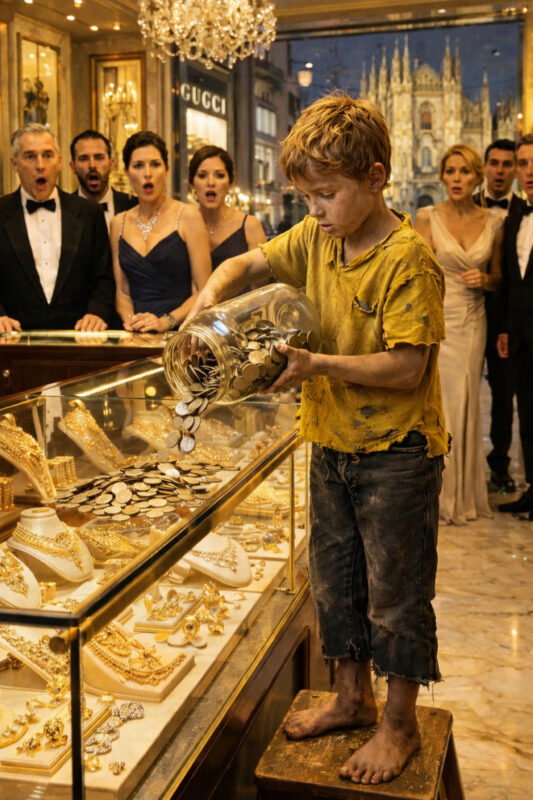
Barefoot. Torn tank top. Jeans stained with dried mud. In his hands, an overflowing black trash bag. His dirty feet left marks across the shining marble floor as he walked.
Customers exchanged uncomfortable glances.
The guard, Mr. Daniels, rushed toward him.
“Hey! No begging in here!” he shouted. “You’re dirtying the floor. Out. Now.”
The boy remained silent.
He kept walking toward the counter.
“I said OUT—”
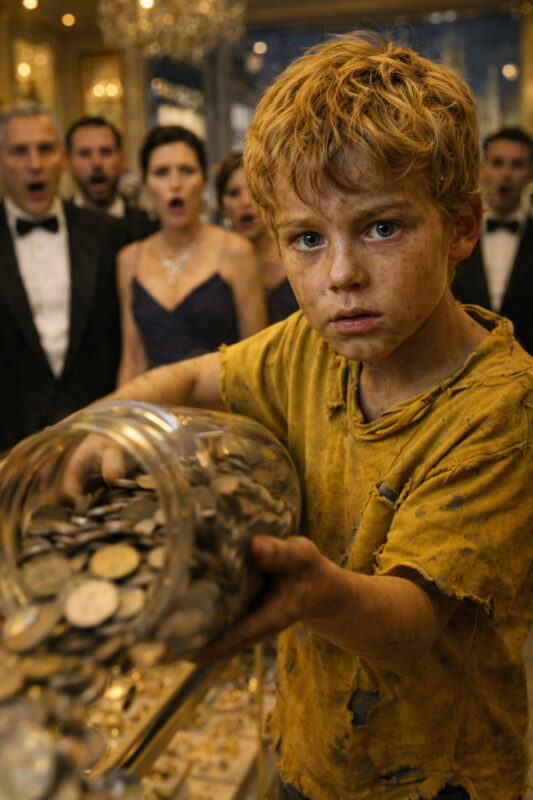
Before the guard could grab his arm, the boy lifted a jar and overturned it onto the glass counter.
CLANG. CLINK. CLATTER.
An avalanche of coins scattered everywhere: pennies, nickels, dimes, quarters. Some tarnished with time, others sticky or slightly dented.
The entire store froze.
And what happened next left everyone speechless 👇👇👇
The store manager, Mrs. Caroline Whitaker, stepped out of her office.
“What’s going on?” she asked.
“I was about to remove him,” the guard replied quickly. “He’s causing trouble.”
The boy swallowed and pulled a crumpled pawn ticket from his pocket.
“I’m not causing trouble,” he said softly but firmly. “I’m here to get my mom’s necklace back.”
Mrs. Whitaker examined the ticket.
Item #2045. Gold necklace with a heart-shaped pendant. Pawned last year.
“Sweetheart,” she said gently, “with interest, that comes to $1,200. Are you sure you have enough?”
The boy nodded and pointed to the coins.
“$1,260. I counted them three times last night.”
His hands were covered in cuts and calluses.
“Where did you get all this?” she asked, moved.
“I collect cans, bottles, scrap metal. I’ve been saving for a year.” His voice trembled. “My mom had to pawn it when I was sick. Tomorrow is her birthday. I wanted to surprise her.”
The store fell silent. The customers who had looked at him with disdain were now wiping away tears. The guard lowered his head in shame.
Mrs. Whitaker opened the safe and brought out the necklace. Simple — a small gold heart — but in that moment, it seemed priceless. She placed it in front of him.

“Here you go, sweetheart.”
The boy pushed the coins toward her.
“That’s the payment.”
She gently took his hand.
“Keep your money. The necklace is yours.”
“F–free?” he whispered.
“Some things don’t have a price.”
But he shook his head.
“I promised to pay for everything. I don’t want my mom to think I got charity.”
Deeply touched, Mrs. Whitaker smiled.
“Then let’s do it properly.”
They counted every single coin. After several minutes, it came to exactly $1,260.
“Receipt for $1,200 — paid in full,” Mrs. Whitaker confirmed, before returning the extra amount to the boy to start a fund for other children like him.
The store erupted in applause. The next day, Michael gave the necklace to his mother. She burst into tears.
Their moment was recorded. The video went viral. The Gold Heart Foundation was launched, offering opportunities to Michael and his mother.
Ten years later, Michael — now a lawyer — stood before a packed room and said:
“That day, I walked into a jewelry store to get back a necklace. But what I really saved was my faith in humanity.”
He still wore the gold pendant — a symbol of dignity, love, and trust.
At Royale Jewelry & Café, a plaque now reads:
“We don’t just sell gold. We believe in the value of people.”
And it all began with a jar of cold coins… and an extraordinarily warm heart.