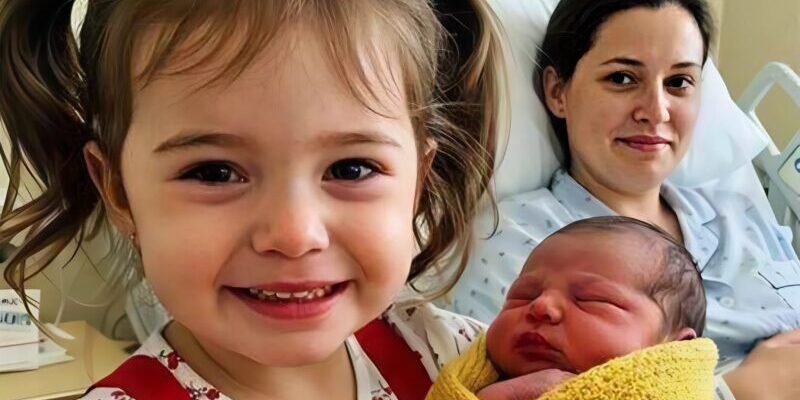
My daughter was amazed to hold her newborn baby sister — until the moment she said something that sent chills down my spine.
Sitting cross-legged at the edge of the maternity bed, her small hands trembling slightly around the tiny body on her lap, Lisa, my four-year-old eldest — wearing her favorite red overalls and her slightly crooked ponytail — looked as though she were holding something precious, almost sacred. A strange light gleamed in her eyes: it wasn’t just excitement — it was a mix of fascination and seriousness I had never seen in her before.
The air smelled of disinfectant and the soft warmth of baby skin, and even though my stitches tugged with every breath after the delivery, all I felt was immense gratitude. Throughout my pregnancy, I had worried about how Lisa would react: would she feel left out, hurt, jealous? But seeing her cradle her sister, whispering gentle “shh” sounds, I thought all my doubts were finally fading.
Then she leaned closer. Her face approached the newborn’s, and she whispered:
— Now I have someone.
I let out an emotional smile.
— Someone for what, sweetheart?
She stayed focused on the baby’s face, still rocking her with the same slow, steady motion, and replied softly:
— Someone to keep the secrets with me.
A cold shiver crawled up my back.
— What secrets, honey? I asked, trying to sound calm.
She lifted her eyes to me then. They were surprisingly serious, too aware for a child her age. She nodded slowly before saying clearly:
— The secrets I don’t tell Daddy.
I didn’t have time to respond or even reach for her little hand. She leaned over the baby again and murmured something else. A sentence that made the heart monitor beside me spike. A sentence that froze the nurse in the doorway, her eyes wide open.
She said…
(To be continued in the first comment: what Lisa revealed next shattered everything I thought I knew about our home…)
👉 Read the rest in the first comment 👇👇👇👇
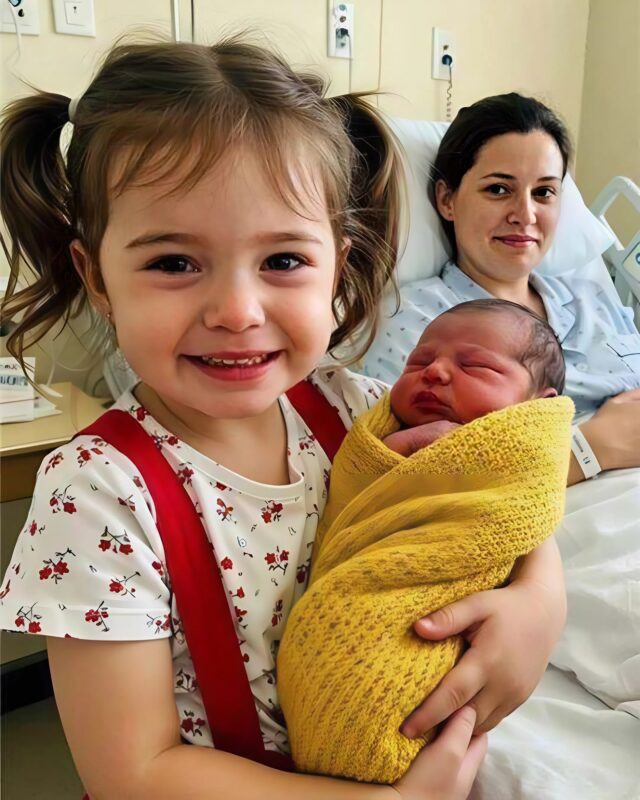
Lisa held her newborn baby sister like a fragile treasure. From my hospital bed, I watched her with that glowing pride of a big sister when she whispered: “Now I have someone I can tell my secrets to… the ones I don’t tell Daddy.” I first thought it was just child’s play, but those words stayed with me.
Days passed, and Lisa kept playing, inventing stories. One afternoon, I heard her whispering to her dolls: “We don’t tell Daddy.” When she noticed me listening, she ran off, embarrassed. A doubt began to grow.
One evening, as the sun was setting, I caught her near the crib, speaking softly to her sister: “If Daddy asks, we say the monster only comes when he’s not home.”
When she described this “monster” — a big black shadow knocking on windows and hiding in the kitchen — a cold sensation gripped me. I tried to reassure her, but her story stayed in my mind.
A few days later, I found a disturbing drawing under her pillow: a dark figure looming over two small shapes, with the words: “Don’t let the monster take her.” We talked to Julien about it and, worried, decided to consult a child psychologist.
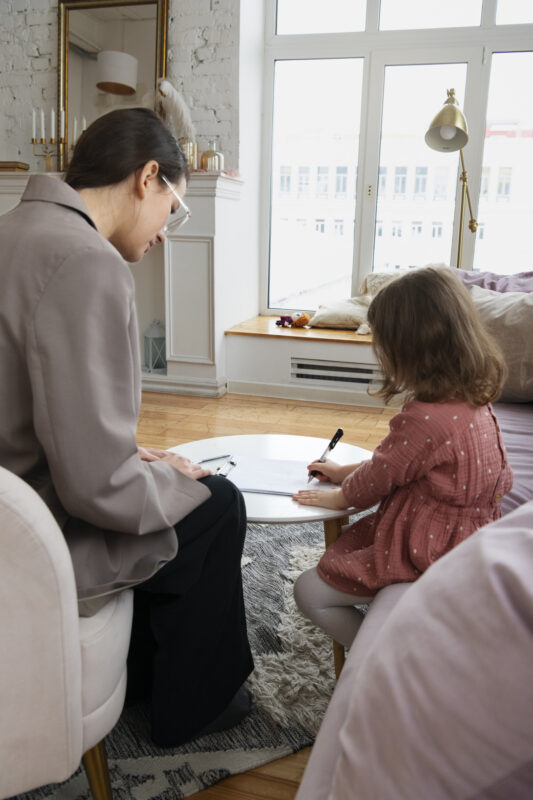
Soon after, Lisa disappeared for a short moment. We found her in the shed, holding her sister tight: “The monster said he’s coming back… and I could give him Lila,” she whispered, terrified. Yet no one had entered our home.
With the therapist’s help, the truth finally came out. The “monster” wasn’t imaginary — it was the form her young mind had given to her father’s anger during my pregnancy. The slamming doors, the smell of beer, the shouting — it had all created a vague, unbearable fear she couldn’t express any other way.
Julien, shattered by this, became aware of the impact of his behavior and committed to changing. Little by little, the atmosphere in the house softened. Lisa smiled again, and her drawings stopped showing shadows — instead filling with clumsy rainbows.
One morning, she simply said: “I don’t have any secrets to hide anymore.”
That sentence erased the last of the monsters.