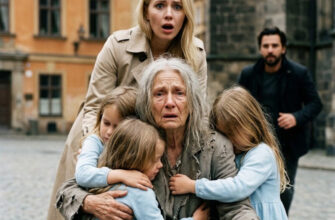
The daughter-in-law was mistreating her mother-in-law, convinced that no one would ever suspect her. The elderly woman kept silent out of love for her son—until the hospital revealed the truth…
No one suspected what was happening behind the light blue door of an apartment in the Noailles district of Marseille. From the outside, nothing seemed unusual: a small balcony, withered plants, shutters almost always closed.
Inside lived Madame Rosette Fernandez, 76, widowed for more than fifteen years. Her husband had passed away too soon, and she lived alone with her only son, Jean-Pascal, until he married Sabrina, 32, five years earlier.
Sabrina—always well-made-up and elegant—smiled at the neighbors and seemed charming. But once the door was closed, everything changed. Harsh words, contemptuous gestures, deprivation. Rosette’s bedroom had become a narrow, isolated refuge, without a television. The kitchen table had disappeared.
“You don’t use it anymore… I’ll bring you food when I have time,” Sabrina would say—sometimes she did, sometimes she didn’t.
Rosette lost weight, her hands trembled, and she spent hours staring at an old photo of Jean-Pascal as a child with his father. Jean-Pascal, for his part, believed his wife.
“She’s getting old, we need to be patient,” he kept saying.
He didn’t know that Sabrina rummaged through his mother’s phone, hid her medication, and whispered, “If you talk, I’ll send you to a nursing home.”
Rosette endured it all—hunger, fear, humiliation. Until the day she slipped in the bathroom and lay on the floor for hours. Sabrina, absorbed by her phone, noticed nothing.
It was Madame Martinez, the downstairs neighbor, who heard her moans and called for help. At Nord Hospital, the doctor asked the fateful question:
“Who takes care of you at home?”
Rosette hesitated, then lowered her eyes.
“No one,” she murmured.
One word that changed everything… 👇 Discover the full story just below, in the first comment 👇👇

Social services immediately activated the elderly protection protocol. A caseworker arrived, examining the old bruises, her thinness, and the silent fear in her eyes.
“Does your daughter-in-law treat you properly?” she asked gently.
Rosette closed her eyes. A tear rolled down her cheek.
“No.”
When Jean-Pascal arrived at Marseille’s Nord Hospital, he found his mother on an IV drip—and Sabrina raising her voice at the caseworker.
“You have no business being here!” Sabrina snapped.

“I’m mandated by social services,” the woman replied calmly. “I have full authority.”
Jean-Pascal felt a knot tighten in his stomach. That evening, he stayed alone with his mother.
“Mom… why didn’t you ever tell me?”
Rosette looked at him, exhausted.
“Because you’re my son,” she answered. “I didn’t want to lose you.”
The next day, the decision was made: Rosette would not return to the apartment. Sabrina exploded.

“She’s manipulating you! She’s a crazy old woman!”
But Jean-Pascal had seen the medical reports, the photos, and heard the testimonies. Above all, he remembered one detail: the apartment still legally belonged to his mother.
A week later, Sabrina received a court summons for violence against a vulnerable person, harassment, and abuse of trust.
Rosette went to live with her sister in Cluny, gained weight, began laughing again, and slept peacefully. Sabrina, for her part, had to face justice.
In the neighborhood, the story spread: a son who opened his eyes too late, a daughter-in-law who mistook silence for weakness, and a mother who—though broken—never stopped loving.