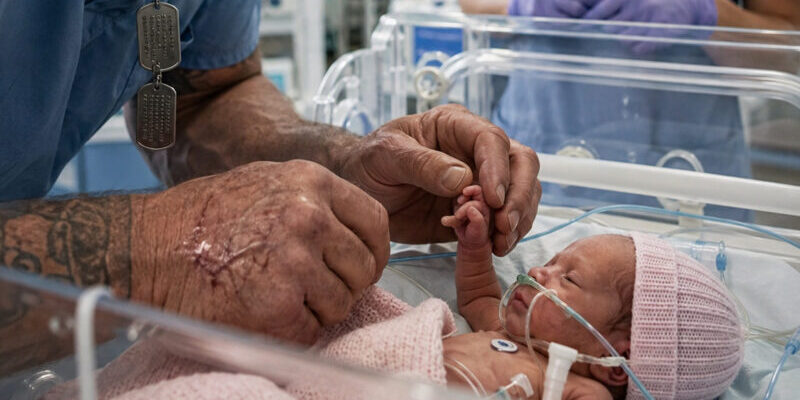
The premature baby in room 9 had neither a real name nor anyone waiting to take her home. Then a 6-foot-6 former soldier, with trembling hands covered in scars, whispered, “Let me hold her.” The nurse almost refused… until his military dog tags came into view.
The Man Outside Room 9: A Stranger in the NICU
The first time Ethan Callahan walked into the neonatal intensive care unit at Riverside Children’s Hospital in Columbus, Ohio, I thought he had taken the wrong floor.
I had been working as a neonatal respiratory therapist for nearly thirteen years. By then, I had learned to recognize the way visitors approached our unit. Young parents usually arrived with worried faces and hurried steps. Grandparents carried coffee cups, carefully folded blankets, and more hope than they could put into words.
Even our regular volunteers walked in cautiously, as if the air itself were too fragile to disturb.
Ethan was different.
He stood nearly six feet six inches tall, with broad shoulders and an upright posture that betrayed years of following military orders. He was fifty-three, although the deep lines around his eyes made him look older.
Pale scars ran from his neck, disappeared beneath his collar, and continued down both forearms. Years earlier, he had been caught in a vehicle fire during an overseas mission. His skin had healed unevenly.
But it was his hands that caught my attention most.
They were large enough to almost completely cover the back of a dinner plate. And they trembled constantly, the result of lingering nerve damage.
Nothing about his appearance seemed to suggest that he belonged around babies so tiny they could have fit inside a winter hat.
Yet his volunteer badge was perfectly valid.
He had passed the hospital’s security checks, completed six weeks of training, and passed all medical and psychological evaluations. He had officially been accepted into our volunteer program for comforting infants.
The program was intended for babies whose parents could not remain at the hospital, particularly those who needed regular human contact during long and difficult recoveries.
Ethan stood silently near the sink while I checked his file for a second time.
Then the baby in room 9 began to cry.
The only name we knew her by was the one listed on her chart: Baby Girl Anderson.
She had been born seven weeks early and weighed barely more than two pounds after a particularly complicated emergency delivery.
Her mother, who had struggled with substance dependence for years, had left the hospital before social services could even complete their mandatory interviews.
The father had never called.
No family member had come to bring a photograph, a blanket, or even a name chosen with love.
Beside the incubator, the space meant for her family remained painfully empty.
In our unit, some babies had handmade signs hanging on the wall and stuffed animals patiently waiting for them to go home.
Baby Girl Anderson had only a printed identification card and a gray hospital blanket.
Her first few days had been marked by painful withdrawal symptoms.
Ordinary sounds made her startle. Bright lights exhausted her. Even gentle touch could make her tiny arms tremble as her heart rate accelerated.
That morning, we had dimmed the lights, repositioned her, checked every IV line, and carefully followed her treatment protocol.
But she kept crying.
A small, high-pitched, desperate cry, astonishingly powerful for such a fragile body.
Ethan turned toward room 9.
His expression changed so quickly that I almost missed it.
The guarded look disappeared, replaced by something softer, something deeply personal.
“Is that the baby who needs a volunteer to hold her?” he asked.
“She needs someone calm,” I replied. “She has a hard time with touch, so we have to go very slowly.”
He nodded.
But I noticed his eyes drop toward his trembling fingers.
I looked at them too.
I’m not proud of it, but I found myself wondering.
Could those scarred hands really hold a baby whose entire head could have fit in one of his palms without putting her at risk?
And could the alarms, shrill noises, and constant urgency of our unit awaken memories in him that he wasn’t ready to face?
Ethan must have understood my hesitation.
“If you think I’m not ready, tell me,” he said. “I won’t take it personally.”
There was no aggression in his voice.
Only disarming sincerity.
I looked at Ethan, then at the incubator, where the baby was drawing her tiny legs toward her stomach.
“Let’s try,” I said. “But I’ll stay right beside you.”
He carefully washed his hands, despite the water splashing against his unsteady joints.
After putting on a clean gown, he approached the incubator and waited for me to open the small access port.
The moment his fingertips touched the mattress, Baby Girl Anderson began crying even harder.
The monitor went off.
Her heart rate increased.
Ethan’s shoulders tightened, as if an invisible weight had suddenly fallen onto them.
For several seconds, he remained completely still.
The alarms didn’t mean the same thing to him that they did to us.
I could see it in his distant expression and in the sudden tension in his jaw.
He was no longer in that warm hospital room in Ohio.
Part of him had gone somewhere else.
Somewhere filled with smoke, metal, and voices shouting orders in the chaos.
“Mr. Callahan, step away for a moment,” I said, reaching toward him.
He closed his eyes and inhaled deeply through his nose.
“Please…” he whispered. “Give me ten seconds.”
I kept my hand near his arm, but I gave him those few seconds.
His breathing slowed.
His shoulders relaxed.
His fingers were still trembling, but he leaned over the incubator again.
“Okay, little one,” he whispered. “None of us likes alarms. We already have something in common.”
And, for the first time since he had arrived, Baby Girl Anderson stopped crying.
…PART 2 IN THE FIRST COMMENT 👇👇👇
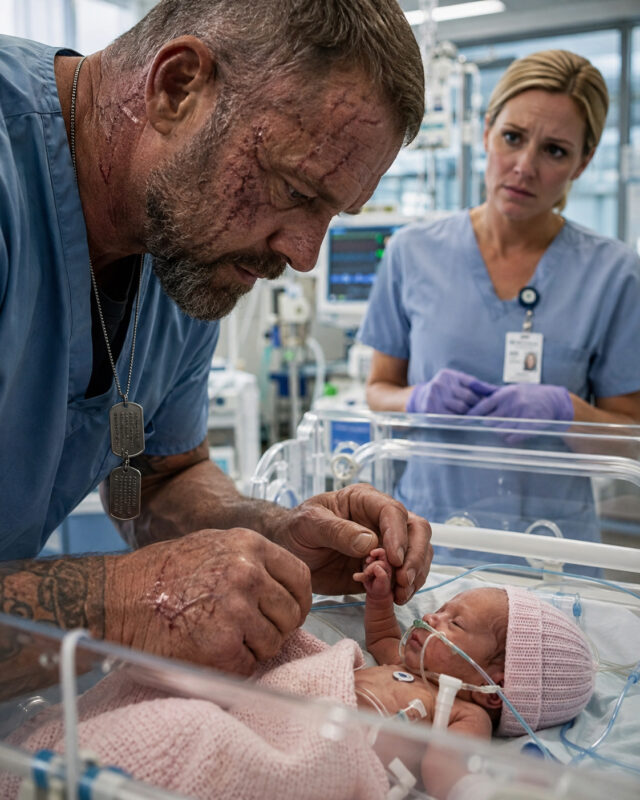
Ethan didn’t immediately pick the baby up. He gently slid one hand beneath her head and the other beneath her back, just as we had taught him. His hands were trembling, but his movements remained steady. He simply waited for the little girl to get used to his presence.
Suddenly, a small silver military medallion slipped out from beneath his uniform. I thought it was one of his own insignia until I read the inscription:
“Major Ethan Callahan — For Michael Anderson — I brought you home.”
Anderson. The same name as the one written beside the incubator.
Michael had been his best friend and combat medic. Twelve years earlier, during a military mission, their helicopter had crashed. Michael had freed Ethan from his harness and gotten him to safety, but he didn’t survive.
Before he died, Michael had made Ethan promise to look after his little sister, Samantha, if she ever needed him.
A few days earlier, Ethan had learned that Samantha had given birth to a premature baby before disappearing from the hospital. He had come to see the baby.
The little girl grew calm in his arms. Ethan began humming an old military melody, turning it into a lullaby. Her heart rate slowed. Then her tiny fingers curled around his thumb.
With tears in his eyes, he whispered:
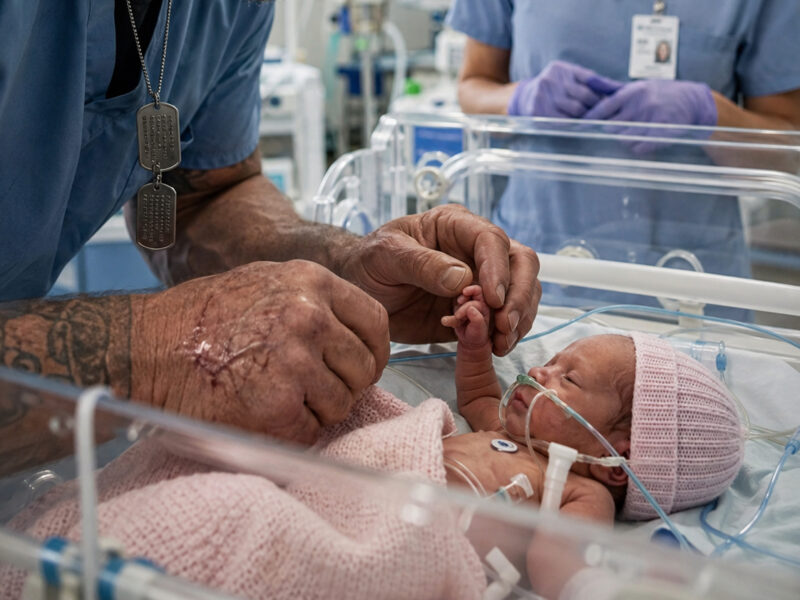
“Your uncle stayed when I needed him. I can stay too.”
From that day on, Ethan returned every evening at 6 p.m. For five weeks, he never missed a visit. We named the little girl Nora, a name her mother had once chosen for her future daughter.
Nora gradually grew stronger. Ethan, meanwhile, began the process of becoming her adoptive father. Despite his injuries, his age, and the doubts of some people, he took classes, prepared a nursery, and built a genuine support network.
A few months later, Ethan was granted permanent custody.
He returned to the unit with a smiling Nora in his arms.
I watched his hands begin to tremble again.
“Does it still bother you?”
He smiled.
“No. These hands don’t need to be perfect. They just need to be there when she reaches for me.”
And that day, I understood that healing doesn’t mean becoming the person you were before.
Sometimes, our wounds can become the shelter someone else needs.