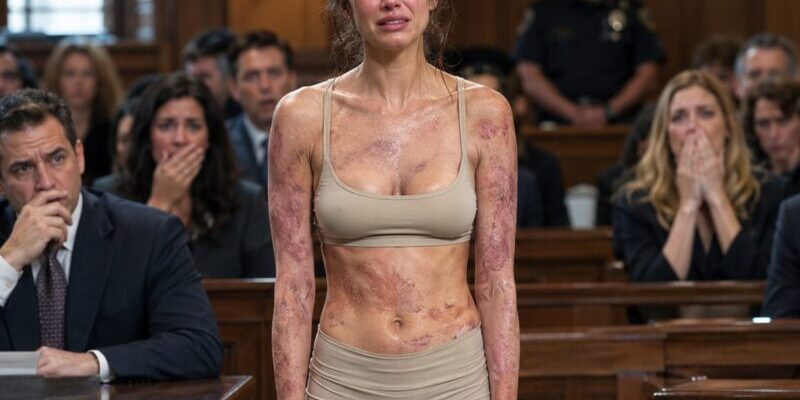
Scalded by my mother-in-law, who wanted to steal my father’s inheritance, I watched my husband smile before demanding a divorce… never imagining that an audio recording would destroy them both…
PART 1:
Boiling oil splashed onto Chloé’s shoulder, streaming down her neck and chest like a river of fire. Her piercing scream echoed throughout the spotless kitchen of their home in Neuilly-sur-Seine. Her legs gave way. She struck the marble countertop before collapsing onto the icy tiles, while the acrid smell of burning fabric filled the room.
A few steps away, Julien, her husband, stood motionless. He watched her writhe in agony on the floor, and then a chilling smile spread across his lips.
“Maybe this time, you’ll finally understand,” he said in a terrifyingly calm voice.
His mother, Éléonore, was still holding the cast-iron frying pan. Steam rose in front of her expressionless face. She appeared neither shocked nor frightened, merely annoyed, as though Chloé had deliberately made a mess of her luxurious kitchen.
For six months, mother and son had been relentlessly pressuring her to sell the three office towers in La Défense that her father had left her before his death. Julien’s property development company was on the verge of bankruptcy: unpaid loans, furious suppliers, and abandoned construction projects were piling up. Yet he continued driving around in his sports car, pretending everything was fine.
“Sell the buildings, transfer the money, and we’ll save the company,” he kept repeating.
But Chloé never gave in.
“No.”
Her father had placed those properties under the protection of a trust. They could neither be used to repay someone else’s debts nor pledged as collateral without special authorization.
That evening, Éléonore had once again tried to force her to surrender.
“Because of you, your husband could lose everything!”
“He won’t lose anything because of me,” Chloé replied. “If he loses everything, it will be because of his own decisions.”
Éléonore clenched her jaw.
“After everything we’ve done to get his projects approved, you still dare to refuse to help us?”
Chloé hadn’t even had time to ask what she meant. Her mother-in-law suddenly raised the frying pan.
The next instant, unbearable pain swallowed Chloé’s entire world.
Lying on the tiles, she saw Julien’s expensive shoes stop beside her face. He crouched down in front of her without the slightest trace of compassion.
“I’m going to file for divorce,” he whispered. “I’m certainly not staying married to a woman who’s going to end up looking like that.”
Éléonore let out a small, contemptuous laugh.
They mistook Chloé’s trembling for submission. In their eyes, the burns, the suffering, and the humiliation would be enough to break her and force her to sign whatever documents they put in front of her.
They waited several minutes before calling emergency services. Meanwhile, Éléonore carefully washed the frying pan, changed her blouse, and cleaned the floor. Julien was already rehearsing his version of events: Chloé had supposedly tripped and accidentally spilled the burning oil on herself by pulling on the pan’s handle.
But they had overlooked one detail.
Inside Chloé’s handbag, resting on a chair, a tiny red light was blinking discreetly.
They had no idea that the device had just recorded their words and actions. More importantly, they never suspected that this recording would expose a network far larger and far darker than their simple attempt to steal an inheritance.
And what Chloé had discovered before that terrible evening threatened to bring down far more than just their company…
❤️ THANK YOU FOR TAKING THE TIME TO READ THIS FIRST PART! 🙏📖
The story is only just beginning… The continuation and the ending have already been posted in the comments! 👇 If you can’t find them, click “View all comments” and look for them to discover what happens next. 💬✨

PART 2:
Julien thought Chloé would remain confined to her hospital room, broken and silent, while he controlled the narrative. But the very next day, Police Captain Anne Lambert arrived to question her, accompanied by a domestic violence specialist and a computer forensics expert.
Chloé handed them her voice recorder. For three years, ever since discovering that Julien had forged her signature on a loan application, she had kept a voice-activated recording device. Everything had been captured: the threats, Éléonore’s laughter, and that chilling sentence: “She’ll sign when she’s scared enough.”
Investigators also recovered the surveillance footage. Julien had unplugged the camera after the attack, unaware that the recordings were automatically backed up to a secure server. The video showed Éléonore preparing the boiling oil, then Julien locking the door.
Before the end of the day, Éléonore was taken into police custody on suspicion of attempted murder. Julien, meanwhile, was formally charged with complicity.
But he was about to make another mistake. In his divorce petition, he demanded control over Chloé’s buildings, claiming that they represented more than €30 million in marital assets. To support his claims, he had attached forged documents.
Attorney Dubois, who had been Chloé’s father’s longtime lawyer, examined them carefully.

“He’s just handed us evidence against himself,” he concluded.
The buildings had been acquired eight years before the marriage. Worse still, one signature attributed to Chloé was dated during a period when she was abroad.
The investigation then uncovered a massive real estate fraud scheme. Julien had forged documents, obtained loans through fraudulent means, and secured approval for buildings with serious construction defects. Éléonore had arranged bribes to buy the silence of certain officials.
Their true motivation finally came to light: six months earlier, Julien had attempted to mortgage one of Chloé’s buildings using forged authorization. When that scheme failed, he borrowed €18 million from investors who were now demanding repayment.
The attack, therefore, had not been an outburst of anger. It was a calculated plan to terrorize her into surrendering her inheritance.
When Chloé learned the truth, she whispered:
“He didn’t want to leave me because he no longer loved me. He wanted to rob me before walking away.”
A few days later, Julien requested a settlement meeting. From her hospital room, Chloé confronted him by video conference.
“I made mistakes,” he tried to justify himself.
“You locked the door. You encouraged her. And you watched me burn with a smile on your face.”

Her lawyer presented the evidence of fraud and the court order freezing Julien’s bank accounts and Éléonore’s assets.
Shortly afterward, Julien was placed in pretrial detention on charges of fraud, forgery and use of forged documents, criminal conspiracy, and corruption. During his arrest, he blamed his mother, who immediately turned around and blamed him.
But the worst was yet to come.
Two weeks later, experts discovered serious structural defects in a residential tower built by Julien. Forty-six families lived there. The building was urgently evacuated, potentially preventing a catastrophe.
After five weeks in the hospital, Chloé finally confronted her reflection in the mirror. Her scars were still there, but she no longer saw a broken woman staring back at her.
She saw a survivor.
Using part of the compensation she received, she established a fund to help the displaced families.
She hadn’t gotten her old life back. She had built a new one, free and dignified.
While Julien and Éléonore awaited trial, each blaming the other, one haunting question stirred debate among readers online:
How often do we call people “family” when the only reason they come close to us is to strip us of everything we have?