
The police handcuffed a young athlete in the street — then she uttered a single sentence that made their smiles disappear 😳🚔
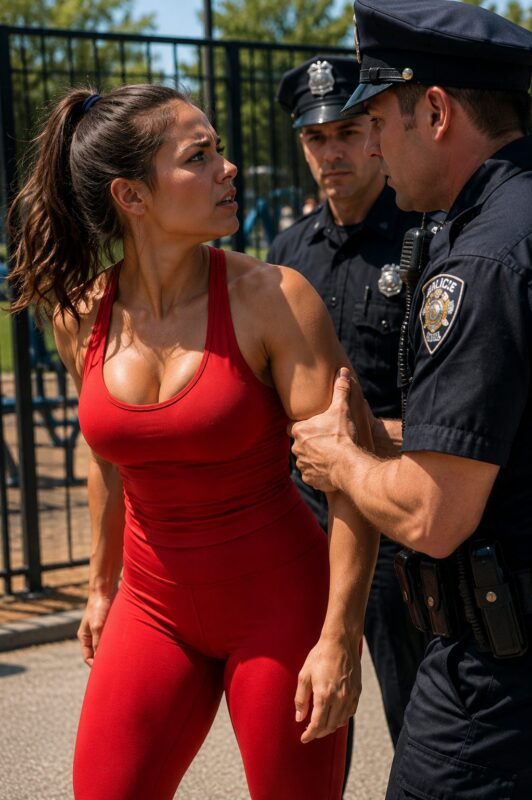
— I’m the one who decides here who has committed an offense! the officer shouted as he grabbed her arm.
The young woman had been training for nearly an hour on a public outdoor sports field. She was running, stretching, and timing her workout on her phone without bothering anyone.
At first, the two young officers watched her from the other side of the fence.
Then they approached her.
One of them started a conversation, but the young woman politely told him that she simply wanted to train alone. The man insisted. When she refused a second time, his tone changed completely.
— Do you even know who you’re talking to?
— A police officer who should leave me alone now, she replied.
Several people stopped nearby. Phones began coming out of pockets.
That was when the officer announced that he was taking her in for insulting an officer and, with the help of his colleague, led her toward their police vehicle.
The young woman did not resist.
Instead, she suddenly became very calm.
— All right. Then let’s do this officially. Body camera, badge number, exact reason for the detention, and a complete report.
The two officers exchanged a glance.
— Are you scared now? one of them asked with a mocking smile.
The young woman simply lowered her eyes toward the pocket of her jacket, her hands still cuffed.
— No. I just want to make sure that later, no one can claim that none of this ever happened.
Then she asked one of the bystanders to take something out of her pocket.
And when the officer saw what it was, he immediately lowered his phone… 😨
The rest of the story in the first comment 👇👇
A bystander carefully slipped his hand into the young woman’s pocket.
He pulled out a black case containing a card.
But the young woman immediately shook her head.
— Don’t open it. Give it to me.
The two officers burst out laughing.
— Now a simple ID card is going to save you?
— No, she calmly replied. The recordings are what will save you… or condemn you.
Then she asked them another question:
— Are both of your body cameras working?
image
The smiles immediately disappeared from their faces.
One of the officers instinctively looked down at his chest.
That was when their supervisor arrived at the scene, having been sent there after noticing the crowd gathering around the incident.
— What happened?
— She insulted an officer on duty! one of the men immediately replied.
The supervisor turned toward him.
— What exactly did she say?
A heavy silence fell over the scene.
But the witnesses immediately began speaking.
— Nothing at all!
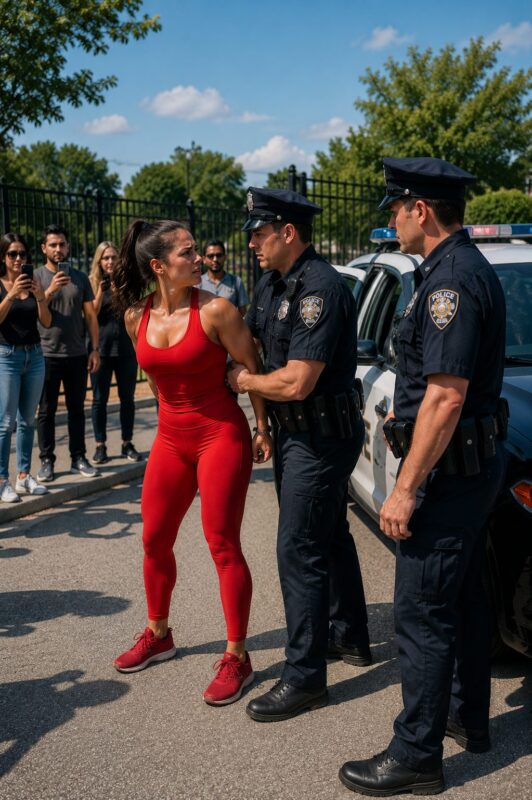
— She was just working out!
— We saw everything!
An elderly man even explained that he had been filming the scene from the very beginning.
The young woman then asked for the handcuffs to be removed.
Once she was free, she opened the black case.
The supervisor’s face tightened.
The woman did, in fact, work as a legal officer within an internal unit responsible for police oversight. Her role included investigating abuses committed in the line of duty.
But that morning, she had genuinely come there simply to work out.
She had not been testing them.
She had not set any trap for them.
And that was precisely what made the situation even more serious.
— So you didn’t behave this way because you knew who I was, she said softly. You did it because you thought I was nobody.
No one answered.
One of the officers still tried to justify himself.
— You misunderstood the situation. We were simply carrying out a routine check…
— Checking what?
Another silence.
The videos recorded by the witnesses clearly showed the officers repeatedly approaching her, her refusal, and then the threatening tone they used.
The body cameras had also captured the incident up close.
The two officers were removed from field duty that same day, while an official investigation was opened.
Later, the young woman asked for only one thing:
That this case not be taken seriously simply because people had discovered where she worked.
She wanted everyone to understand that such behavior should have consequences, even if the victim were a waitress, a student, or a mother rushing to work.
A few weeks later, she returned to the exact same place to train.
At the same time.
She put on her headphones, started the stopwatch on her phone, and resumed her workout.
That morning, no one came to bother her.
And in the end, the most important question in the entire story was not:
“Do you know who you’re dealing with?”
But exactly the opposite:
Why should we have to know who someone is before deciding to treat them with respect?