My wife has been in a coma for two months, and our seven-year-old son refuses to spend a single day away from her hospital room. Every afternoon after school, he sits beside her bed, holds her hand, and tells her about his day. Tonight, I finally tried to convince him to come home and sleep in his own bed.
But when I told him it was time to leave, he looked at me and said:
“Dad, I can’t leave Mom on Saturdays.”
“Why?”
“Because that’s the day she talks to me.”
I thought he was imagining things. Then he asked me a question that left me speechless.
“Dad, why are you afraid to stay here with me?”
Suddenly, I realized my son knew something I didn’t.
Two months earlier, I had been away on a business trip when my mother called.
“Jeremy, you need to come home.”
Something in her voice immediately worried me.
“Mom, what’s going on?”
“It’s Emma. She’s in the hospital.”
I froze.
“What happened to her?”
“She’s in a coma. Noah is with her, and he refuses to leave. You need to come home immediately.”
I packed my things and left right away.
Even today, I feel guilty for not being there when Emma needed me. I know I couldn’t have predicted what would happen, but that knowledge does little to ease my regret.
It had now been sixty days since I’d heard my wife’s voice. Sixty days of walking into her hospital room, hoping to see her open her eyes.
Our son, Noah, is only seven years old. As soon as school ends, my mother takes him to the hospital. He does his homework beside Emma’s bed, reads her his favorite stories, and tells her everything that happens at school. Sometimes, he falls asleep in the chair next to her.
Almost every evening, he asks if he can stay. And far too often, I say yes.
My mother and I were beginning to worry. Noah needed rest, time with his friends, and the chance to live like a child his age without constantly carrying the weight of his mother’s condition.
That evening, I pulled up a chair beside him. He was reading a Marvel comic book, completely absorbed in the story.
“Hey, champ, can we talk?”
“Sure, Dad.”
“I know you’ve been taking care of Mom all this time. You’re incredibly brave. But even superheroes need rest. How about we go home tonight? You can sleep in your own bed, and we’ll come back tomorrow.”
Noah slowly closed his comic book.
“What day is it?”
“Saturday.”
His expression changed.
“Then I can’t leave.”
“Why is Saturday different?”
“Because Mom won’t have anyone to talk to.”
I tried to smile.
“You can talk to her tomorrow.”
He shook his head.
“No, Dad. You don’t understand.”
He leaned toward me and lowered his voice.
“Mom talks to me on Saturdays.”
I stared at him in disbelief.
“What do you mean?”
“She answers me.”
I thought he was joking.
“Noah, Mom can’t talk right now. I hope she can hear us, but she can’t answer us the way she used to.”
He watched me silently before asking:
“Have you ever stayed long enough to find out?”
I didn’t know what to say.
“You always come here, Dad, but then you leave to get coffee or answer your phone.”
I looked away. He was right. I visited Emma every day, but I always found an excuse to leave the room. A phone call, a nurse I needed to speak with, a work problem… Anything to avoid sitting alone with my helplessness.
Then Noah asked me a question I wasn’t prepared for.
“Why are you afraid to stay in Mom’s room with me?”
I froze.
Because he was right. I was afraid of the silence, of my helplessness, and of the possibility that Emma might never open her eyes again. I was also afraid of all the things I hadn’t said to her before my last business trip.
Noah wasn’t trying to blame me. He was simply waiting for an answer I couldn’t give him.
Then he took my hand.
“Stay tonight, Dad.”
I looked at Emma, lying motionless in her hospital bed, while the medical equipment made its steady, rhythmic sounds.
Noah gently squeezed my fingers.
“Just stay with me. Then you’ll understand.”
Finally, I nodded.
“Okay, buddy. I’ll stay.”
He smiled, moved his chair closer to his mother’s bed, and opened his comic book again.
For the first time in weeks, I didn’t reach for my phone or glance toward the door. I was going to stay.
As the quiet of Saturday evening settled over the room, Noah took his mother’s hand, looked at me, and whispered:
“Okay, Mom. Dad’s here this time.”
What happened next finally made me understand why my son was so determined to stay by her side.
Discover what happened next in the first comment. 👇👇
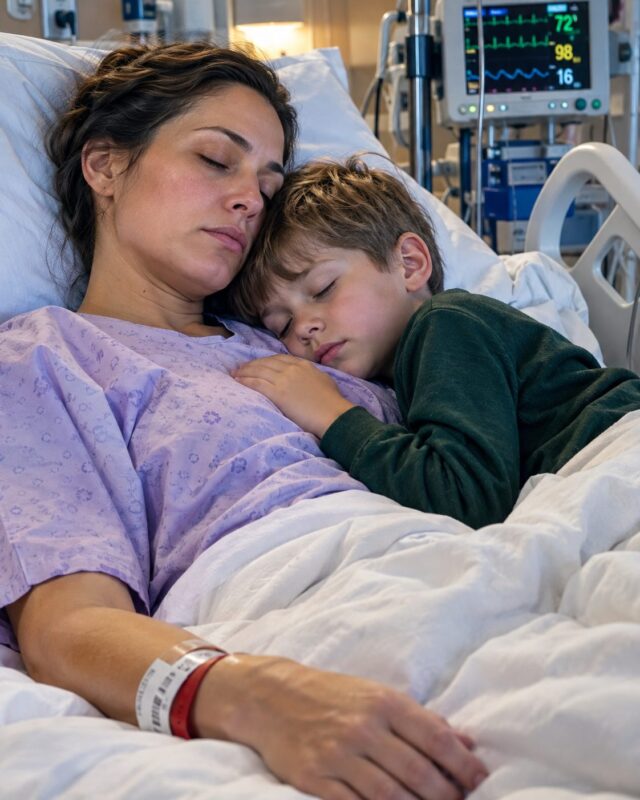
I agreed to stay.
For nearly an hour, nothing happened. Noah told Emma about his school day, his spelling test, and the pancakes Grandma had burned.
“They weren’t burned!” my mother protested.
“They were completely black, Grandma!” Noah replied with a smile.
Around 7 p.m., my mother went home. I stood up to get some coffee, but Noah immediately reminded me of my promise.
“You said you’d stay!”
I sat back down. Twenty minutes later, he moved closer to his mother’s bed and took her hand.
“Mom, is Dad here with us?”
Suddenly, Emma’s index finger moved once.
“See? She said yes!” Noah exclaimed.
He explained that one movement meant “yes” and two movements meant “no.”
I was skeptical. Patients in comas could make involuntary movements, but I agreed to test it.
“Mom, is my name Noah?” my son asked.
Her finger moved once.
“Am I nine years old?”
This time, it moved twice.
With my heart pounding, I asked another question.
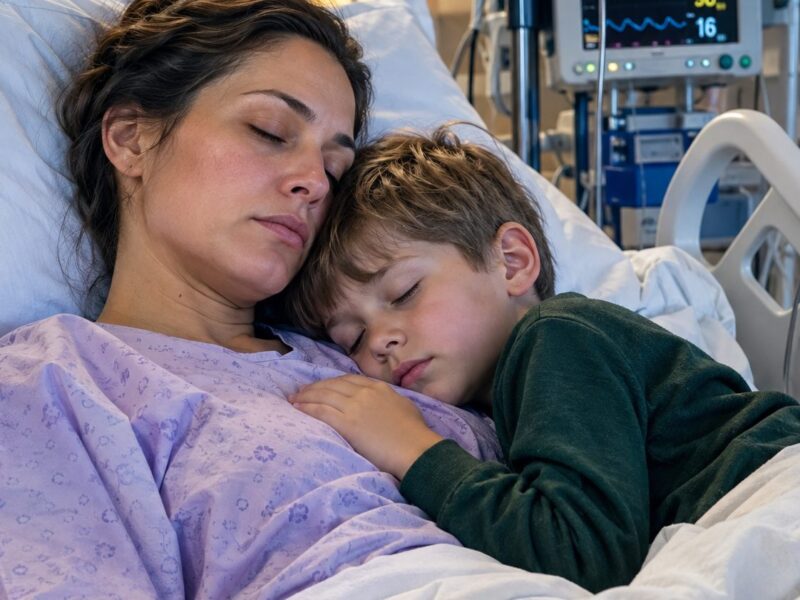
“Emma, is Noah seven years old?”
After a few seconds, her index finger moved once.
I was stunned.
Noah then confessed that this had been happening for four Saturdays. He had tried to tell us, but we had assumed he was misinterpreting his mother’s movements.
“I thought you wouldn’t bring me to see her anymore,” he whispered.
Then he asked me a painful question.
“Dad, why do you always leave when everything gets quiet?”
I realized he had noticed my fear. For two months, I had kept myself constantly busy to avoid being alone with my helplessness.
He reminded me of the argument Emma and I had the night before my business trip. She had asked me to stay, but I had left, promising we would talk when I returned. We never got the chance.
I had felt guilty ever since she was hospitalized, even though I knew my departure hadn’t caused her condition.
“But you love Mom,” Noah said.
“More than anything in the world.”
“Then stay with her.”
He turned toward Emma.
“Mom, do you want Dad to stay?”
After a few seconds, her index finger moved once.
I squeezed her hand, overwhelmed with emotion.
For the first time, I understood that I didn’t have to fix everything immediately. I simply needed to be there.
“You don’t have to carry this responsibility all by yourself anymore,” I promised Noah. “I’ll take care of Mom.”
I then informed the medical team about what we had observed. The doctors explained that such movements could be difficult to interpret, but they began monitoring Emma closely.
That night, Noah went home to sleep in his own bed, reassured by the knowledge that I would stay beside his mother.
I held Emma’s hand until morning.
“Forgive me,” I whispered. “I thought being a good husband meant fixing everything. I forgot that sometimes, all you have to do is be there.”
Over the following weeks, Emma began showing small signs of improvement. Noah returned to spending time with his friends and enjoying his childhood, while continuing to visit his mother after school.
Saturdays remained special, but now I stayed too.
One day, Noah asked me to ask Emma a question.
“Do you think he’ll ever learn how to spell the word ‘separation’ correctly?”
“Dad, that’s not funny!” Noah protested.
I chuckled softly, then watched my wife’s hand.
A few seconds later, her index finger moved once.
Noah burst out laughing, and I joined him.
I had believed my son refused to leave because he couldn’t accept his mother’s condition. In reality, he thought his presence was essential and that no one else could take his place.
There is a difference between visiting someone you love and truly being present for them.
It took a seven-year-old boy and one tiny movement of his mother’s finger to teach me that lesson.
This time, I wasn’t going anywhere.
THE END.