“May I clean your house for a plate of food?” — but when the millionaire saw her, he was petrified
The rain was pouring violently onto the glass roof of the billionaire’s luxurious mansion on the outskirts of Seattle. Inside, Adrien Morel stood near the fireplace, a cup of black coffee in his hands, his gaze lost in the dance of the flames. He had grown used to silence; even in this sumptuous palace, he had never known the warmth of true human presence. Success had given him fortune, but never inner peace.
A sharp knock echoed in the vast hall.
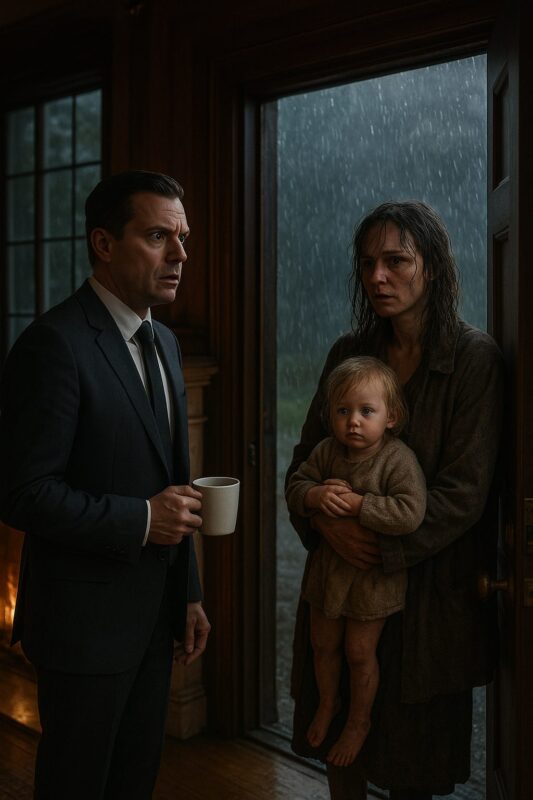
Adrien frowned. He was expecting no one: his staff was on leave and visitors were rare. He set down his cup and walked to the door. When he opened it, he discovered a woman, drenched to the bone, holding in her arms a little girl barely two years old. Her clothes were worn, her eyes hollowed by fatigue. The child, silent, clung to her mother’s sweater while curiously observing the place.
— “I’m sorry to disturb you,” the woman said in a trembling voice. “I haven’t eaten in two days… I can clean your house, just for a plate of food for me and my daughter.”
Adrien froze.
His heart stopped, not out of pity, but out of shock. He remained silent for a few seconds…
— “Clara?” he whispered… 👉 Read more in the first comment 👇👇👇👇

The young woman raised her head, her mouth slightly open in surprise.
— “Adrien?”
Time seemed to collapse on itself.
Seven years earlier, she had disappeared without explanation, without goodbye. She had vanished from his life.
Adrien was shaken: Clara, his great love, stood before him, unrecognizable. And in her arms, a little girl with blond curls and light eyes… eyes that looked just like his. When he asked if the child was his, Clara turned her gaze away without answering. Yet Adrien already knew.
He let them in, offering them warmth and food. The little girl, named Léna, clung to him with instinctive trust. Adrien felt his heart break: he had missed years of his daughter’s life.
Sitting across from him, Clara finally confessed the truth. She had discovered her pregnancy at the very moment his company was going public. Adrien worked day and night; she did not want to be a burden. Then, the fatal blow: a cancer diagnosis. Convinced she had no chance, she chose to disappear to spare him suffering. She had given birth alone, fought alone, survived alone.
Adrien, torn between anger and sorrow, could not help but reproach her for that choice: she had not given him the chance to fight by her side. But seeing Léna smile as she bit into a strawberry, he understood that what mattered now was the future.
In the following days, Clara stayed at the mansion. Little by little, a routine took shape: Adrien cooked for his daughter, learned to braid her hair, took her to the garden. Clara, still wary, slowly regained a taste for life and picked up her paintbrushes again, her forgotten passion.
But everything was not easy. Adrien’s mother, a cold and ambitious woman, came one day to confront Clara, accusing her of trying to take advantage of the family fortune. Hurt but dignified, Clara thought of leaving. Adrien stopped her: “You and Léna are my family. No one will take you away from me.”

Time did its work. Resentments eased, wounds began to heal. Adrien realized that wealth had never had any value without them. Clara discovered that despite the years and the pain, her love for him had never disappeared.
One spring morning, under a blooming magnolia tree, Adrien knelt down and held out a ring. With tears in her eyes, Clara accepted.
Léna, clapping her tiny hands, burst out laughing. And that laughter, more than anything, was the promise of a new beginning.