I asked my ten-year-old students to write down their biggest worry; I expected things like “homework” or “monsters”, but the answers they gave me broke my heart—I was shocked
For thirty-nine years, I have been Mrs. Albright, in room 2B, with my 4th-grade class. In a year, I will retire. My classroom has become a time capsule: the posters I laminated in 1992 never left the walls, and I still believe in the stubborn beauty of cursive handwriting. And, I admit, I still believe a little in the “good old days.”
I watch my students, their small faces absorbed in their parents’ phones at pickup time, and a strange sadness fills me. I grew up in the seventies. My childhood dramas amounted to a scraped knee. Theirs today seem to encompass everything the world can throw at them.
One Tuesday, I brought a relic from my childhood: my 1973 metal lunchbox, bright red and decorated with an astronaut.
— “Kids,” I announced proudly, “this is my lunchbox. Back in my day, our biggest worry was whether mom packed ham or peanut butter.”
They stared back in silence.
— “You all seem very serious these days… So let’s play Then & Now.”
I wrote on a card: “My biggest worry? Being picked last in dodgeball.”
A few giggles broke the tension. It felt good.
— “Now it’s your turn. Anonymous. Write what weighs on you. Then fold your card and drop it into the astronaut’s lunchbox.”
Silence fell instantly. Only the scratching of pencils could be heard. Mark, usually so talkative, sat still, eyes lost in the ceiling. Emily wiped away a tear before writing. One by one, they deposited their cards, the soft thud of paper on metal strangely loud.
— “Alright! Let’s see what’s changed!”
I pulled out my own card and joked. Nobody laughed.
When I opened the next paper, my smile froze, suspended by what I had just read. 👉 Full story in the first comment 👇👇👇👇

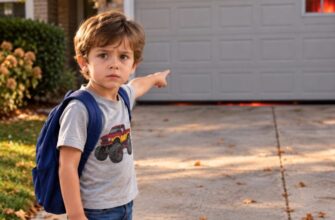
“I’m scared when the doorbell rings after dark. Mom turns off all the lights and tells us to hide under the covers. I think it’s the man from the bank.”
My breath caught. I grabbed another.
“Mom cries in the shower so no one hears her. I heard her tell Grandma that the ‘medicine’ doesn’t work anymore and that she’s ‘so tired.’”
Another.
“My big brother says if I tell Dad what he does in his room, he’ll post the ‘bad video’ of me crying on the internet. I don’t even know what video he means.”
Another.
“I try not to eat so I can look like the girls on Mom’s phone. But I’m always hungry.”
Another.
“I check Dad’s closet every morning. He said he needed to ‘find himself’ and he’d come back. His shoes are still gone.”
I kept going. For ten minutes. The whole class held its breath.
I read stories about parents who were “asleep” and never woke up. About screams through apartment walls. About fear of the news. And from a little boy who simply wrote: “I wait for the bus alone. Nobody ever waves goodbye to me from the window.”
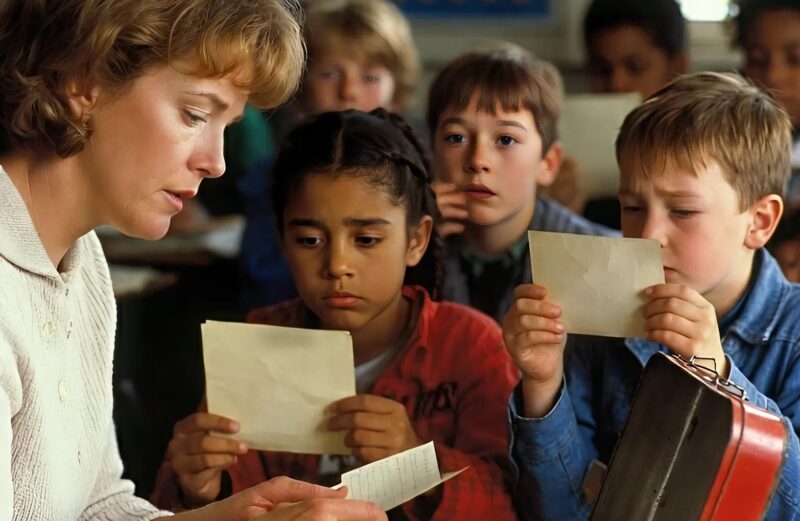
When I finished the last card, my voice was gone. I stood up again.
The “good old days” were a lie. Or worse: a privilege.
In front of me, they weren’t children. They were tiny terrified survivors, wearing superhero t-shirts.
I saw Emily, the “perfect” little girl, quietly reach out to Mark, “the talker.” He squeezed her hand so tight.
I looked back at my own card: “Being picked last in dodgeball.”
That silly, insignificant, bright fear. A fear that only exists in a world gentle enough to allow a child to worry about so little.
I clenched the card in my fist. I didn’t throw it away. I placed it back in the lunchbox, with all the others. It belonged to them now.
— “The good old days…” I murmured, my voice broken. “It wasn’t better back then. Just… simpler. We were allowed to stay children longer.”
The bell rang. No one moved.
That metal box no longer sits on my shelf as a keepsake. It rests on my desk as a reminder. We are a society obsessed with pretending everything is fine. We post the vacation photo, not the fight that came before it. We show the perfect house, not the foreclosure notice taped to the door.
And our children are watching. They’re not “too complicated.” They’re just living in the world we built.
We need to stop telling them, “Be strong,” and start asking, “Is it heavy today?”
We don’t need to fix their problems. We just need to prove they’re not carrying the weight alone.