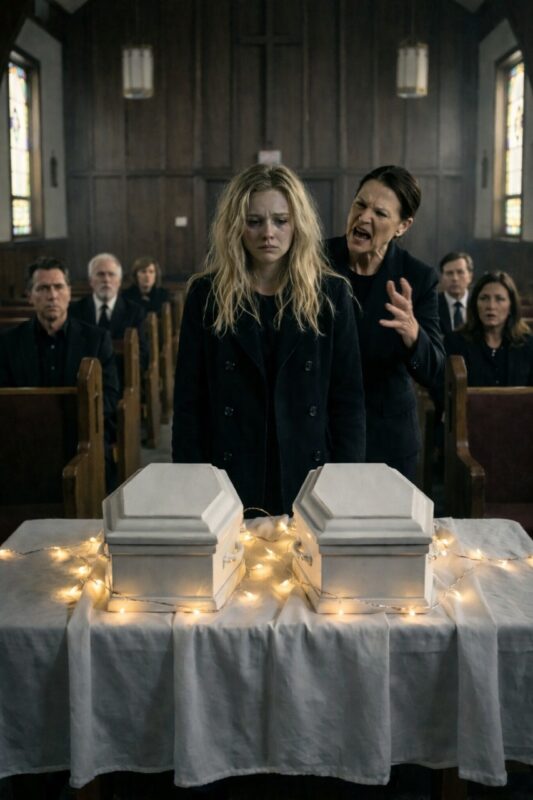
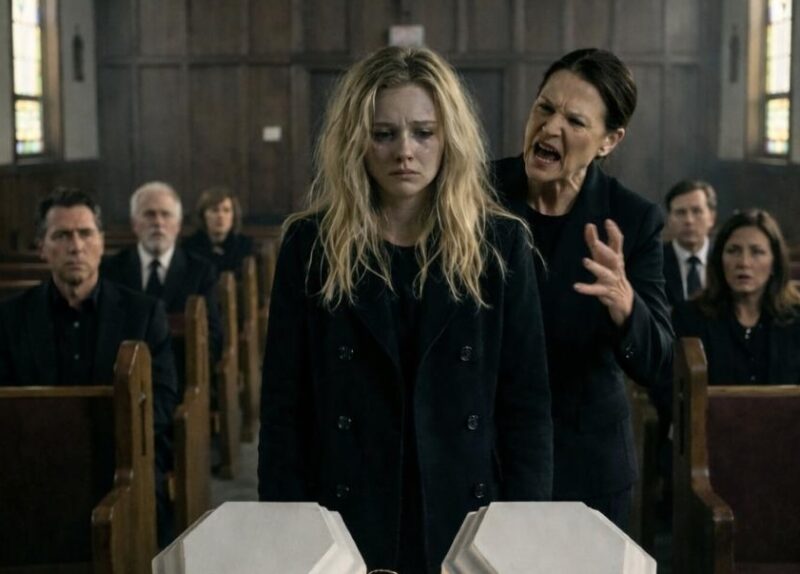
At the funeral of my twin babies, as I stood frozen in front of their tiny white coffins, my mother-in-law leaned toward me and whispered in an icy voice,
“God took them because He knew what kind of mother you were…”
Something broke inside me. I burst into tears and screamed, my voice torn apart by pain:
“Can you please be quiet, just for today? Just one day…”
I didn’t have time to say anything else.
A violent slap cracked across my face, louder than the muffled sobs in the chapel. My head slammed into the edge of the coffin. The impact was dull and brutal. Then, right next to my ear, she hissed through clenched teeth:
“If you don’t shut up, you’ll end up with them.”
But what happened next… no one saw it coming.
================
My name is Sarah Morel, and the day I buried my twin babies is the day something inside me collapsed forever.
Two small coffins lay side by side at the front of the chapel, barely longer than my arm. Élise and Lucas. They fell asleep. And they never woke up.
The doctors called it sudden infant death syndrome. Those words spun in my head like a cruel, meaningless joke.
I stood there, motionless, clutching a withered rose in my trembling fingers, when I felt a presence behind me.
My mother-in-law, Hélène Morel.
Her perfume was overpowering. Nauseating. Her voice, low and venomous. When she spoke those words, they hit me like a punch.
I turned around, tears streaming freely down my face. “They’re dead… Haven’t you said enough already?” I screamed, shattered.
A heavy silence fell over the congregation. Then the violence.
Her hand came down on me. My hair was yanked back. My head slammed against the white wood of the coffin. I felt blood running down near my ear, the metallic taste filling my mouth.
My husband, Julien, stood a few steps away, frozen, eyes wide open. No one intervened. The priest merely cleared his throat, unable to react.
At that exact moment, something changed inside me. It was no longer just grief. It was clarity.
I understood that Hélène’s cruelty had not been born from this tragedy. She had always hated me—because I married her son, because I quit my job for my children, because I didn’t fit her perfect image of an ideal family.
As I leaned against the coffin, shaking with rage and humiliation, I noticed, in the front row, a figure slowly raising a phone.
She was recording.
And at the exact moment my tears fell onto the white wood… I knew that these funeral services would not end the way Hélène had planned.
👉 Full story in the first comment 👇👇
I then noticed someone sitting in the front row, secretly filming the scene. After the ceremony, Julien accused me. “You provoked her,” he said. Those words hurt far more than the slap itself.
That same evening, Camille, my husband’s cousin, sent me the video. As I watched it, my hands trembled—not with sadness, but with anger.
Then more messages arrived. People shared stories of Hélène behaving this way for years. I wasn’t the first. I had simply been the one too many.
So I made a decision. I contacted a lawyer and filed a complaint. On the day of the hearing, Hélène sat upright, confident. Until the judge ordered the video to be played.
Her cruel voice filled the courtroom. When the recording ended, something had changed. For the first time, fear was visible on her face.
Since Élise and Lucas passed away, it was the first time I truly felt heard. Hélène was found guilty of assault.
She wasn’t sent to prison, but the court sentenced her to mandatory therapy, community service, and a permanent mark on her record. A clear decision: grief never excuses violence.
Julien didn’t come home with me that day. Shortly after, we separated. I finally stopped listening to those who told me that “because it’s family,” I should forgive.
I moved into a small apartment. On the wall, I hung two photos: Élise asleep, and Lucas gripping my finger with his tiny hand.
Every Sunday, I visit their graves with peace in my heart, no longer fear in my stomach. Hélène wrote to me once. There were no apologies—only justifications. I never replied.
Healing came slowly, in silence, through small, quiet moments of strength. When people ask me today if I regret filing that complaint, my answer is simple: no.
Silence protects abusers. My voice saved me.