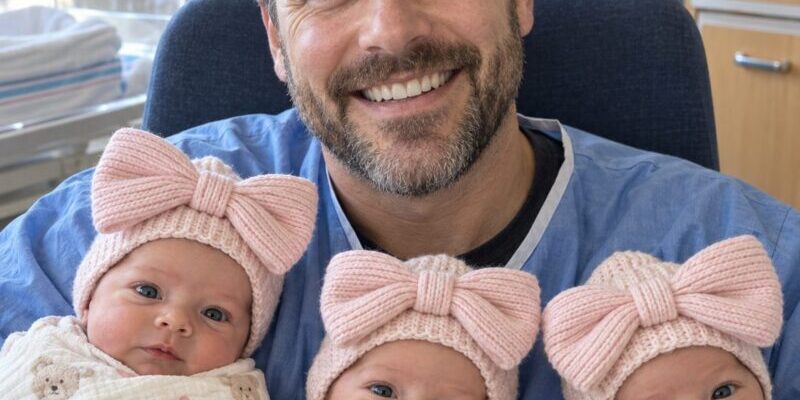
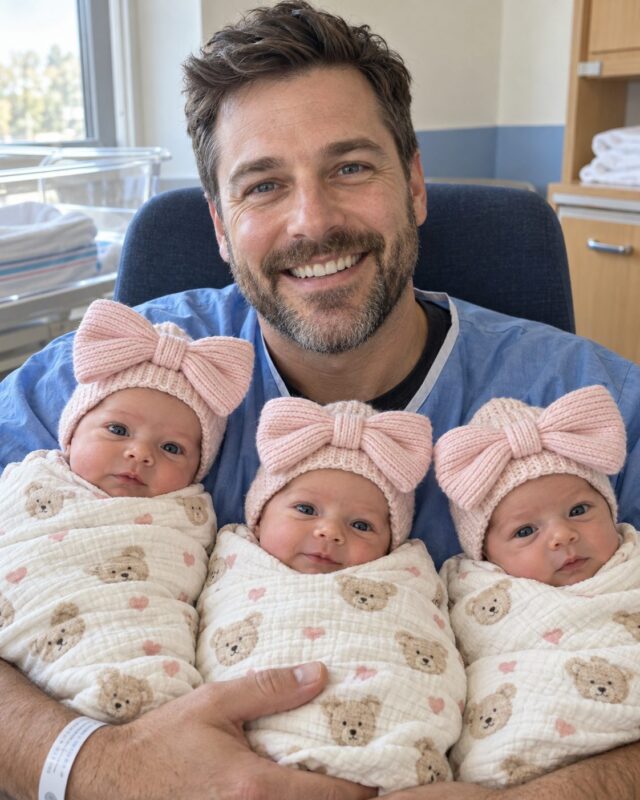
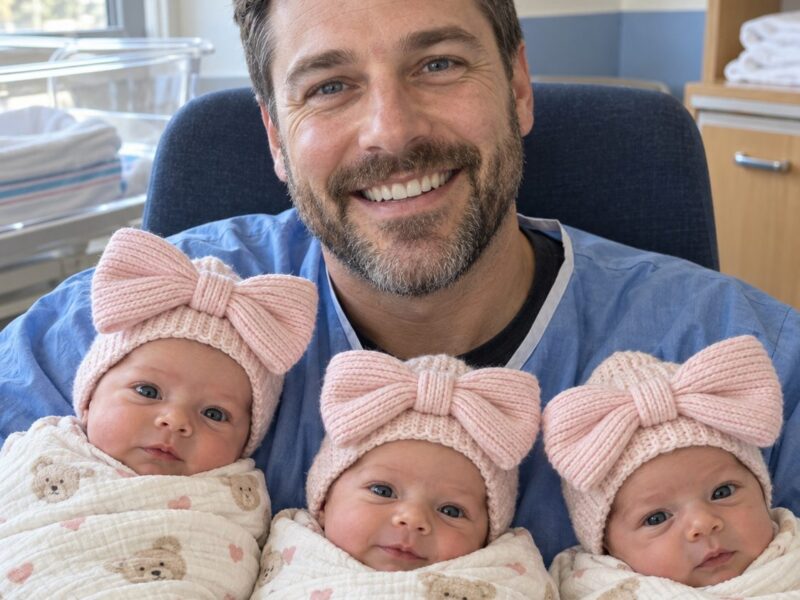
After ten years of heartache, I finally gave birth to triplets. My husband held two of them in his arms and cried tears of joy; then he picked up the third, noticed something on her neck, turned pale, and whispered:
“This little girl… we can’t keep her.”
For almost ten years, my husband, Nathan, and I had wanted a child more than anything in the world. There had been doctor’s appointments, tests, treatments, and so many disappointments that I no longer even wanted to think about them.
Eventually, I began to lose hope.
I even stopped buying pregnancy tests. You have no idea what it feels like to stare at one negative test after another, desperately hoping that this time, something has changed.
Nathan, meanwhile, threw himself into preparing everything like a man possessed. He painted the nursery himself in a soft pastel green, working late into the night with the windows wide open. He assembled three little cribs and proudly showed me each one when he finished, as though they were trophies.
His mother, Evelyn, came over almost every weekend.
One Saturday, she arrived with a small wooden figurine wrapped in tissue paper. It was a carved woman with her arms stretched out in front of her. The paint had almost completely worn away.
“It belonged to Nathan’s grandmother,” she explained, placing the figurine on the front porch. “It’s for protection.”
Behind her, Nathan rolled his eyes and nodded.
“Sorry,” he whispered.
The girls were born by scheduled C-section at thirty-four weeks.
The first cry was thin, furious, and perfect.
“Baby A,” someone announced. “It’s a girl.”
Amelia.
A minute later came a second cry, louder and angrier than the first.
Sophie.
Then a third, higher-pitched cry rang out through the room.
Lucy.
Three tiny, indignant voices filled that white room.
I was exhausted, trembling, completely drained. Yet as I heard them for the first time, I thought that I had never loved anything as much as I loved them at that very moment.
Then the nurse handed Sophie to Nathan.
He kissed her forehead over and over, pressing tiny, gentle kisses against her skin.
“Hello, sweetheart,” he whispered. “I’m your daddy. I’ve waited for you for so long.”
I remember lying there, stitched up, in pain, and utterly exhausted, thinking that I had never felt such powerful love.
Then his expression changed.
It happened instantly, as though someone had flipped a switch.
His smile vanished.
The color drained from his face.
He went completely still.
“Nathan?”
He didn’t answer.
His eyes were fixed on Lucy’s neck.
“Nathan, what’s wrong? Is she okay?”
He looked up at me. His face was as white as the hospital sheets.
Then he said the words I would hear for the rest of my life:
“This little girl… we can’t keep her.”
I stared at him, unable to understand.
“What are you talking about?”
Nathan didn’t answer right away. He was still looking at Lucy.
Then, in a trembling voice, he whispered:
“That mark…”
I looked down at our daughter’s neck.
And that was the moment I realized something was terribly wrong.
The little mark on her skin looked eerily similar to the one on the old wooden figurine his mother had brought over a few days earlier.
And Nathan seemed to recognize it.
Far too well.
The story continues in the comments! ⬇️⬇️⬇️
“We can’t keep her.”
I thought I had misheard him.
“What?”
Nathan was staring at Lucy’s neck.
“Look…”
Just below her ear was a large, irregular red patch that had been there since birth. The doctor later explained that it was a congenital capillary birthmark, a benign malformation of the tiny blood vessels in the skin.
To me, it was just a birthmark.
But Nathan was terrified.
“The girls in my family who are born with that mark bring bad luck. They destroy everything around them.”
I thought it was some terrible joke. Then Evelyn walked into the room.
When she saw Lucy’s neck, she went deathly pale.
“No… not again.”
I immediately held my daughter tightly against me.
“She’s not going anywhere.”
Evelyn stared at Nathan.
“You know what happened to Claire.”
“Who is Claire?” I asked.
Nathan’s silence chilled me.
Evelyn finally answered:
“His sister.”
After we returned home, Nathan told me that Claire had been sent to live with an aunt when he was eight. His mother claimed that Claire had caused every misfortune in the family: a miscarriage, Nathan’s illness, his father losing his job, and their money problems.
We found an old photograph of Nathan as a child with Claire. She had exactly the same red birthmark.
Eventually, we tracked Claire down.
She told us the truth: she had never brought anyone bad luck. Her parents had simply looked for someone to blame after losing a baby. Her father had even known that the superstition wasn’t true.
But Nathan was still afraid.
So we decided to consult a specialist. After examining Lucy, the doctor explained that her birthmark was a well-known congenital vascular condition. It had absolutely no connection to her personality, her future, or anything that might happen to her family.
“This child is not responsible for any of it,” he told us. “A mark on her skin cannot cause the misfortunes you associate with your family’s history.”
Nathan remained silent for a few seconds, then took Lucy into his arms.
For the first time, he looked at that mark without seeing a curse.
He simply saw his daughter’s skin.
And he whispered:
“You never brought bad luck, sweetheart. You came into our lives to bring us happiness.”