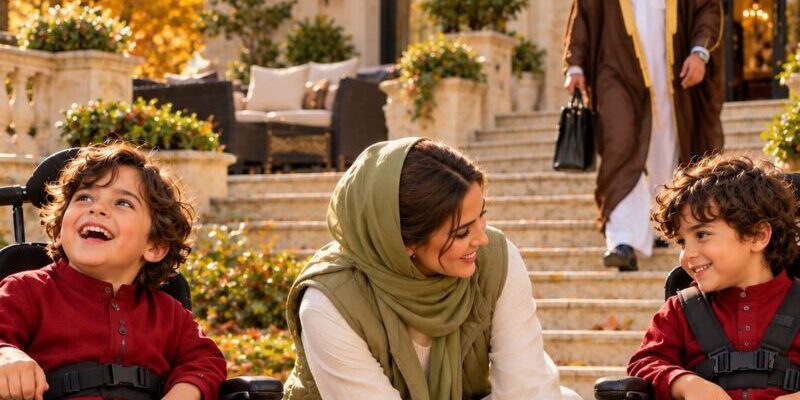
“Your sons will never walk,” the doctors had told him… Then, one afternoon, the sheikh father came home earlier than expected… and froze when he discovered what the nanny was doing with his two boys 😱 😮
For five years, he had been told that his twin sons would never take a single step on their own. Then, one afternoon, their sheikh father saw something in the garden that left him speechless.
The two little boys’ lives revolved around medical examinations, treatments, and wheelchairs. Their father had tried everything: specialists, rehabilitation sessions, expensive equipment…
Nothing had changed the doctors’ opinion.
Then a new nanny arrived.
She promised no miracles. She never spoke of an impossible cure. She simply began encouraging the boys to move through playful activities, giving them a small exercise to try each day.
One autumn afternoon, the sheikh came home earlier than expected.
From inside the house, he heard his children laughing in the garden.
He stepped out onto the terrace… and froze.
The nanny was kneeling between the two wheelchairs. She was gently adjusting one boy’s leg while the other shouted excitedly:
“Dad, look! I’m almost there!”
“Almost able to do what?” his father asked.
The nanny looked up at him.
Her expression changed instantly.
“I wasn’t ready to show you this yet…”
Then she removed her hand from the boy’s leg.
And the little boy did something his father had been told for five years he would never be able to do… 😮❤️
Read the full story in the comments 👇👇

The boy’s right leg moved forward a few inches.
He didn’t take a step.
He didn’t stand up.
But he had made that movement entirely on his own.
“Do it again,” his father said.
The nanny immediately raised her hand.
“That’s enough for today.”
“I SAID, DO IT AGAIN!”
“He’s tired.”
It was the first time anyone in that house had dared to say no to the sheikh so simply.
The father walked over to his son.
“Did you move your leg by yourself?”
The little boy nodded proudly.
“I could already do it yesterday.”

The father looked at the nanny.
“Yesterday?”
That was when he discovered that this movement wasn’t the result of one extraordinary afternoon.
For weeks, the nanny had been inventing games for the boys. They rolled a ball back and forth, moved to the rhythm of music, stretched out their arms to grab objects… and every small movement they managed on their own was treated as a victory.
She had never promised them that they would walk.
Quite the opposite.
“I never promised them something I couldn’t guarantee,” she explained. “I simply didn’t want their diagnosis to make them afraid of trying what they are capable of doing today.”
The next day, the sheikh called in the rehabilitation specialist who had been treating the two boys.
He expected the doctor to immediately announce that this was an extraordinary breakthrough.
But after carefully examining the children, the doctor sat down across from him.
“This isn’t a miracle.”
The father’s expression tightened.
“I saw him move his leg.”
“And that matters. But saying that a child may never be able to walk independently doesn’t mean that the child is incapable of making progress.”
At that moment, the father realized how badly he had misunderstood the past several years.
He had become so obsessed with one goal—seeing his sons walk—that he had almost stopped noticing everything they were capable of learning and accomplishing.
The nanny had noticed.
She had seen that one of the boys was becoming increasingly able to shift his weight.
She had also noticed that the other could now initiate certain movements without assistance.
Most importantly, she had understood something essential: both boys hated being spoken about as though they were nothing more than their medical conditions.
That evening, the sheikh entered the children’s bedroom.
The two boys were building a toy track on the carpet.
“Dad,” one of them asked, “are you angry with her?”
“No.”
“Then can she stay?”
The father smiled.
“If she wants to.”
The nanny stayed.
But beginning the very next day, she no longer worked with them alone. Their father asked specialists to develop a new rehabilitation program that took into account not only their safety, but also their actual abilities and independence.
A few months later, one of the boys managed to remain standing for several seconds while holding onto something for support.
Meanwhile, his brother raced down the hallway in his wheelchair so fast that their father struggled to keep up with him.
There was no miraculous fairy-tale cure.
But something else happened.
The household stopped waiting for the two boys to someday become the people others had imagined they should be.
Instead, everyone began celebrating what they were capable of doing right now.
And for the first time, their father understood that hope does not mean denying limitations.
Hope means refusing to let those limitations define an entire life.