She had barely buried her husband when her son and daughter-in-law demanded that she look after their pets, never imagining that their final humiliation would cost them far more than they expected… 😲 😥
I had barely buried my husband, and no one knew that, that very same week, I had bought a ticket for a year-long cruise.
When my son showed up at my house and dropped three cages in my living room as though I were his personal maid, I realized my mourning had just come to an end.
My daughter-in-law didn’t even bother to greet me. She simply set the cages on my rug and announced:
“Here are the instructions.”
I smiled.
At dawn, when my ship left the port of Miami, my disappearance would turn their lives upside down.
The scent of candle wax and funeral lilies still lingered throughout the house when Austin walked in without even knocking.
It had only been a week since Ernest had passed away.
I had buried him on a gray Tuesday, dressed in the white linen shirt he loved so much. His rosary had been carefully placed between his hands, and I had slipped a small photograph of Key West into his pocket, like one last secret I wanted him to take with him.
For seven days, I had cried until my eyes ached.
On the eighth day, I bought my cruise ticket.
It wasn’t an impulsive decision.
After forty years of being everyone’s backup plan, their emergency wallet, their nurse, their cook, their chauffeur, their babysitter, and the silent listener who absorbed all their problems, I had finally understood one simple thing.
Grief was terribly heavy.
But being constantly used was even heavier.
When Ernest fell ill, I sold the earrings he had given me to help pay for his medication.
When Austin lost his job, I emptied my savings because he swore he only needed a little help to get through a difficult time.
When Chloe had her baby, I spent three months sleeping on their couch. I got up in the middle of the night to prepare bottles while she told everyone I was “so lucky to finally have a purpose in life.”
Then, on the day of Ernest’s funeral, my son didn’t even hug me.
Instead, he looked at the cemetery dirt still clinging to my shoes and asked:
“Mom, have you thought about what you’re going to do with the house?”
That question stayed with me all week.
So when Austin returned wearing a new shirt, dark sunglasses, and that commanding tone Chloe seemed to have taught him, I knew exactly what kind of man my son had become.
“Mom, we’re going to the Bahamas for a few days.”
“That’s nice, sweetheart.”
“You’re going to look after the pets.”
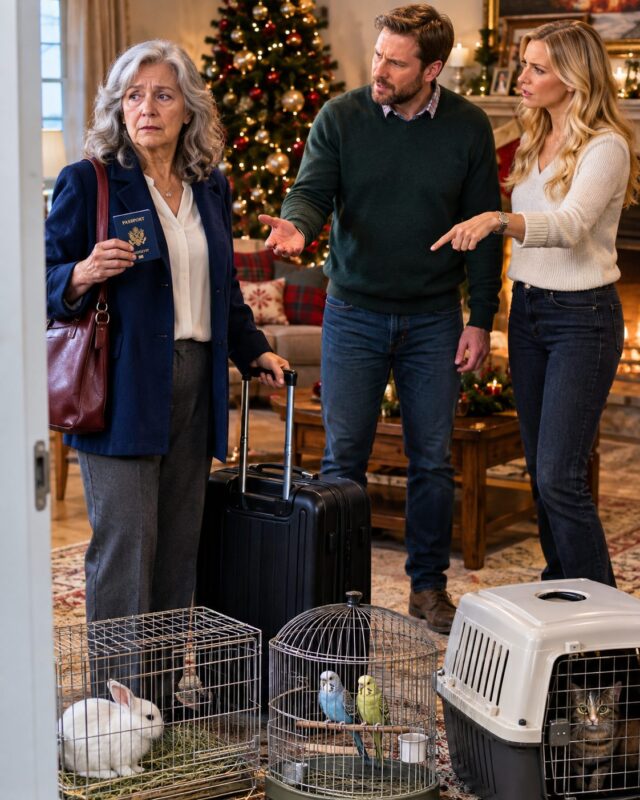
Chloe came in behind him, three cages bumping against her legs.
Two parakeets were squawking at the top of their lungs in one of them.
A white rabbit trembled nervously in another.
As for the cat, it was shut inside an old carrier, pressed against the back as though even it understood it had been brought somewhere it didn’t belong.
Chloe set the three cages right beside Ernest’s memorial photograph. No flowers, no hug, not even a simple:
“How are you holding up?”
Just cages, bags of pet food, and a list of instructions.
“Change the parakeets’ water twice a day,” Chloe said without looking up from her phone. “Absolutely no lettuce for the rabbit. The cat gets stressed easily, so don’t let it out. And make sure you clean up after them, because they really stink.”
I looked at her.
“Chloe, I’ve just buried my husband.”
She let out a long, weary sigh, as though my grief were interfering with her vacation plans.
“Oh, Miss Theresa… everyone has problems.”
Austin didn’t show the slightest embarrassment.
He didn’t stand up for me.
He simply shrugged.
“That’s what you’re here for anyway, Mom. You’ll get bored all by yourself.”
The parakeets kept squawking.
Beside Ernest’s photograph, the candle flame flickered sideways before settling again.
For the first time in my life, I didn’t feel anger rising inside me.
Instead, a strange sense of peace washed over me.
I looked at the cages, then at my son, and smiled.
“Of course, sweetheart. Leave them with me.”
Chloe paused, clearly surprised that I had agreed so easily.
“We’ve also left you the spare keys to our apartment, in case you need to pick up more food.”
Austin leaned down and kissed my forehead with the casual affection of someone giving a piece of furniture a little pat before leaving the room.
“Thanks, Mom. We can always count on you.”
When the door closed behind them, those words seemed to hang in the living room.
They could always count on me.
And that was precisely the problem.
Want to know what happened next?
Read the FULL story in the comments. 👇👇👇
When the door closed behind them, I stood motionless for a few seconds.
Then I took a deep breath.
“We can always count on you, Mom.”
I repeated the sentence quietly before smiling.
“Not anymore.”
I looked at the clock.
It was 4:20 p.m.
My ship was leaving the next morning at ten.
That night, I barely slept. Not because I was sad, but because, for the first time in forty years, I was making plans for my own life.
At six in the morning, a taxi arrived to pick me up.
Before leaving, I placed an envelope on the kitchen table.
Inside was a letter for Austin.
I hadn’t sold the house.
I hadn’t given them any money either.
But I had made a much more important decision: I had removed my name from all the bills, insurance policies, and joint accounts that still allowed my son to live at my expense.
And above all, I had sold the old family home to an investor, just as Ernest and I had decided months earlier.
Austin didn’t know.
No one knew.
On the ship, my phone began to vibrate.
Then again.
And again.
“Mom, where are you?”
“Why doesn’t your number work for the bills anymore?”
“The house is sold?!”
Then one final message from Chloe:
“You can’t do this to us. We needed your help.”
I looked at the vast sea in front of me.
For the first time, I didn’t feel like answering.
Three days later, Austin learned that his old family account had been closed, that the house did not belong to him, and that all the expenses he had made me cover for years were now his responsibility.
But the biggest shock was waiting for him in my letter.
“My son, I gave you everything I could. My money, my time, my love, and even those later years when I should have been taking care of myself.
You thought I would always be there.
You were wrong.
I’m not leaving to punish you.
I’m leaving because I’ve finally understood that my life belongs to me, too.
Take care of yourself.
Mom.”
I placed my phone facedown on the table.
Before me, the ocean sparkled in the sunlight.
Ernest was gone.
But for the first time in a long while, I was no longer afraid of the future.
I was free.