
“Go back to your room!” the daughter-in-law snaps at her husband’s hungry father in front of his grandson… But her husband heard everything, and his reaction changes the entire family forever…
Armand, an elderly grandfather who devoted his entire life to raising his son Julien, timidly asks his daughter-in-law, Élodie, if he can sit at the table and have dinner with the family. But her response leaves him deeply hurt.
“Excuse me, Élodie… I’ve barely eaten anything today. Would it be all right if I sat down and had dinner with you?” he asks hesitantly.
Élodie looks up at him, visibly annoyed.
“Armand, we’d like to enjoy a peaceful evening together as a family. Can’t you understand that we need some privacy too? You’d better go back to your room.”
The old man lowers his head, his heart aching.
“I just wanted to share a meal with you… I didn’t mean to bother anyone,” he murmurs.
But Élodie, far from being moved, adds coldly:
“And most importantly, don’t tell Julien anything. I have no desire to hear him complain about me because of you.”
Those last words were the cruelest of all. Armand slowly lowered his head. His lips trembled, but he said nothing. His eyes filled with tears that he struggled to hold back. He wasn’t asking for privileges or special treatment. He simply wanted to share a meal with his loved ones, like any father or grandfather.
What hurt him most wasn’t the hunger. It was realizing that after spending his entire life building a home for his son, he now had to ask permission to have a place in it.
He turned around and was about to return to his room, his heart heavy, when a voice rang out behind him.
“Dad, wait.”
Armand froze.
Julien had just come home. He stood in the doorway, having heard the entire conversation. His face showed restrained anger, but behind that anger, deep sadness was visible in his eyes. He couldn’t believe that his own father, the man who had sacrificed so much for him, could be treated like an intruder under his own roof.
He walked over to Armand, gently took his arm, and led him to the table.
“Dad, wait! Where are you going?” he asks, seeing the devastated expression on his father’s face.
Then, turning toward his wife, he says firmly:
“Élodie, did you really just speak to him like that? To my father, who sacrificed everything for me?”
And what Julien does next will leave Élodie speechless and shake the entire family to its core.
Read the rest in the comments. 👇👇
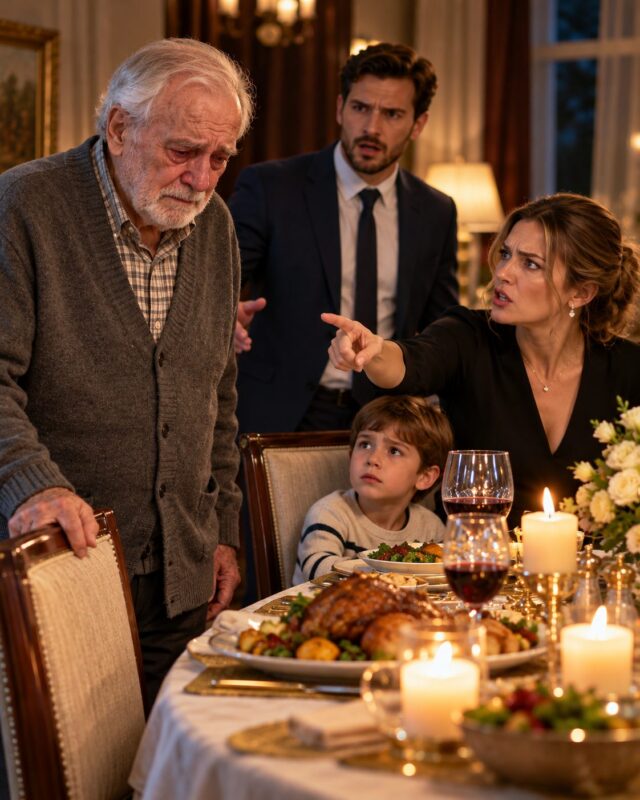
“Sit down, Dad. In this house, you never have to ask permission to eat, to sit down, or simply to exist. This is your home too.”
Then he took a plate, filled it generously with food, and placed it in front of him.
“You spent years taking care of me. You went without so much just to make sure I never lacked anything. And now you’ve been reduced to asking whether you’re allowed to share a meal with us?”
His voice broke slightly on those last words.
“You didn’t raise me so that you would feel like a stranger in your own family, Dad.”
Armand looked away, unable to hold back his tears any longer. Julien placed a hand on his shoulder and stayed beside him, making no attempt to hide his emotions.
At that moment, their daughter rose from her chair. She walked around the table, threw herself into her grandfather’s arms, and kissed him tenderly on the cheek.
“Grandpa, I want you to sit next to me. It’s so much better when you eat with us. You always tell me such wonderful stories.”

Armand held her tightly. For the first time in a long while, a genuine smile lit up his face.
Élodie, meanwhile, remained silent. The look in her daughter’s eyes, the pain visible on her husband’s face, and the old man’s tears reflected an image of herself that she could no longer ignore. She had just hurt someone who had never asked for anything more than the right to live with dignity among his loved ones.
That evening, after dinner, Julien had a long conversation with his wife. He reminded her of the years of sacrifice his father had made, the nights he had stayed awake caring for him when he was sick, the endless working days, and all the times Armand had given up his own comfort to secure his son’s future.
“You don’t have to share everything with him,” he explained, “but you owe him respect. He doesn’t deserve to feel unwanted in the house where he lives. And I will never allow my father to believe that he is a burden to us.”
For the first time, Élodie realized that her little remarks, her sighs, and her repeated refusals had gradually turned Armand’s everyday life into a series of silent humiliations.
The following morning, she approached him in the kitchen. She had spent part of the night thinking about what had happened the evening before.
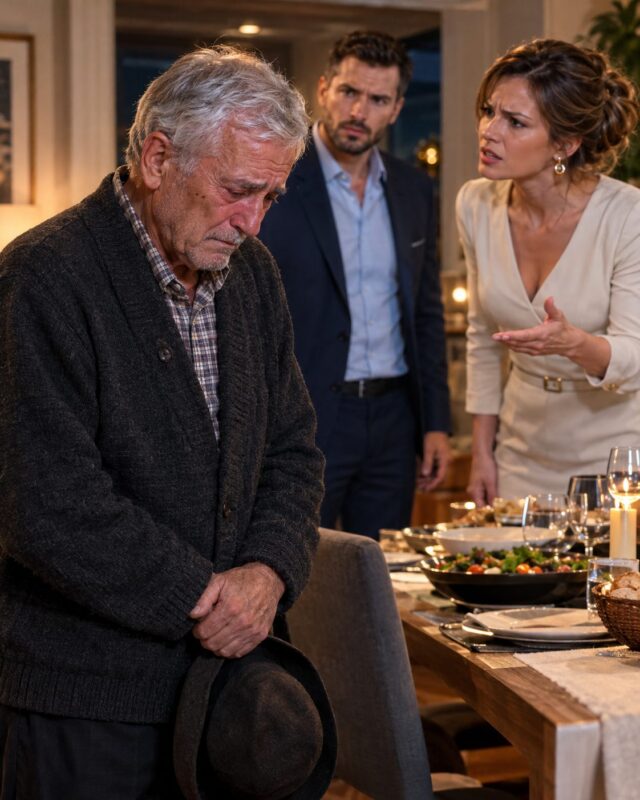
“Armand, I want to apologize to you. What I said was unfair and cruel. You didn’t deserve to be treated that way. I let my selfishness get the better of me, and I’m ashamed of it.”
Armand looked at her for a few seconds. He could have reminded her of every hurt she had caused him and made her understand just how deeply her words had wounded him. Yet he chose not to add more reproaches to the shame she already felt.
“We all make mistakes, Élodie. But we must have the courage to acknowledge them and change. Words can hurt deeply, even when we say them without thinking. We must never forget that someone can suffer in silence for a very long time before anyone notices.”
Élodie lowered her eyes, moved by his response. She understood that this man’s forgiveness was a chance she could not afford to waste.
From that day forward, the family’s habits gradually changed. They no longer ate separately. Every evening, they gathered around the same table, shared news about their days, recalled memories, and enjoyed moments of closeness. Élodie made more time to talk with Armand, while their daughter eagerly told him everything that had happened during her day.
Little by little, Armand regained his place. He was no longer the man who hesitated in a doorway or held back his requests for fear of being a nuisance. He was once again a father, a grandfather, and a full member of the family.
Because the true wealth of a home is measured neither by the size of the house nor by the comfort it provides, but by the way the people who love us are treated within its walls.
One day, those who have devoted their lives to caring for us grow old and sometimes need a little attention in return. They don’t always ask for much: a place at the table, a kind word, a loving glance, or simply the reassurance that they are not unwanted.
Let us never forget that a parent can endure exhaustion, sacrifice, and years of loneliness. But they should never have to beg, in their own home, for the respect and affection they have so generously given to others.