
A school nurse discovers something unusual beneath a 7-year-old boy’s socks — Then authorities are called
In Mesa, Arizona, the temperature had climbed above 99°F (37°C) as students began arriving for another day of school.
Seven-year-old Leo stood out immediately from the other children.
He was wearing thick black wool socks that reached almost to his knees.
His teacher, Ms. Gable, had noticed the same thing every day since Leo had joined the school three weeks earlier.
No matter how hot it was, he always wore the same thick socks. And that was only one of several things that concerned her.
Leo was quiet, even for a child who was naturally shy.
He rarely joined the other students in games during recess.
In class, he often seemed distracted.
At lunchtime, he ate very little.
Ms. Gable had tried talking to him several times, but Leo usually responded with a simple nod or just a few words.
She couldn’t identify any specific reason to believe something was wrong.
Still, her instincts told her to keep paying attention.
That morning, Ms. Gable saw Leo arrive with his stepfather, Mark.
Their interaction seemed tense.
Leo remained seated in the vehicle longer than expected before slowly getting out.
As he walked toward the school, he repeatedly adjusted the thick socks covering his legs.
Ms. Gable greeted him. Leo barely looked up at her.
His face appeared pale despite the intense heat.
She decided to check on him again later that day.
By late morning, the school building had become particularly warm.
Ms. Gable was teaching when she suddenly heard a chair fall.
Leo had collapsed beside his desk.
His face was pale, and he appeared disoriented.
Ms. Gable immediately called the school nurse.
The thick clothing around his legs made the situation especially concerning.
Staff members took him to the nurse’s office, where Nurse Sarah began examining him.
Before becoming a school nurse, Sarah had worked in emergency care.
She recognized signs in Leo that were consistent with a serious heat-related condition.
Her priority was to lower his temperature and stabilize him while determining whether additional medical assistance was needed.
She removed his shoes and was about to take off his thick wool socks.
But when she tried to remove them, Leo began trembling.
“No… please. Don’t take them off.”
Sarah stopped.
The intensity of Leo’s fear did not seem to be simply embarrassment about someone seeing his legs.
Ms. Gable noticed it too.
Leo kept repeating that they must not look beneath his socks.
He also said that someone might hurt another person if the socks were removed.
Sarah realized that she now had two responsibilities.
She needed to treat Leo’s medical condition.
But she also needed to understand why this child was terrified of anyone seeing his legs.
Because Leo was suffering from the heat, leaving the thick clothing in place was no longer an option.
Sarah gently pulled down one of the socks.
What she discovered was not simply a medical problem.
Sarah immediately closed the door to the nurse’s office and contacted school security.
She asked staff to restrict access to the building and call emergency services….
👇 Discover the full story just below, in the first comment 👇👇
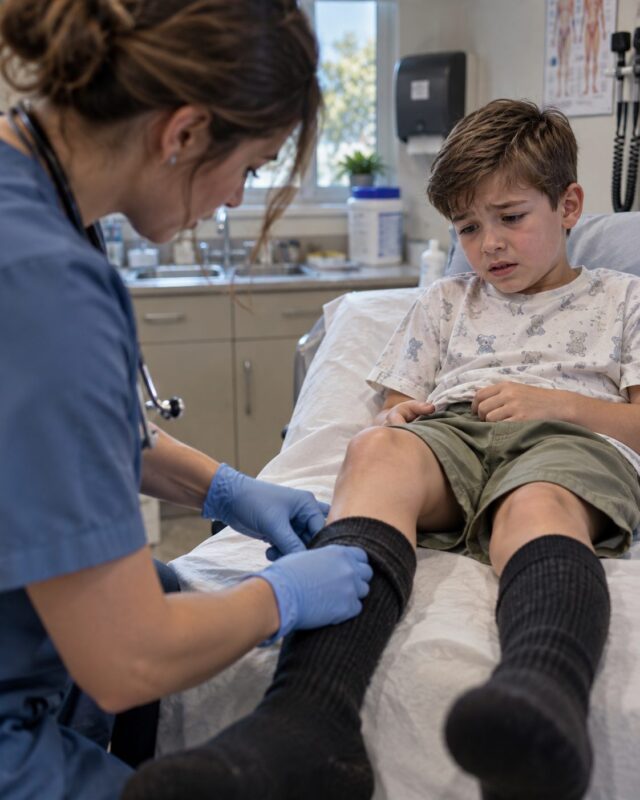
An electronic device resembling a restraint system was fastened around Leo’s lower leg. The condition of the skin around the device suggested that it had probably been there for some time. Nurse Sarah refused to remove it herself, fearing that it might be remotely controlled. She immediately requested assistance from school security and the police.
Security officer Greg Davis examined the device and reviewed the security camera footage. The footage showed that the vehicle that had dropped Leo off was still parked near the school, increasing the urgency of the situation.
Leo then revealed that his stepfather, Mark, had forbidden him from showing anyone what was underneath his socks. He feared that the device might alert Mark if someone discovered it. Despite the technical uncertainty surrounding the device, Sarah took his fears seriously.
Leo also revealed that his mother, Elena, was still at home and that she, too, had been threatened. Police immediately dispatched a team to the family home while another unit headed to the school. The school was placed under a precautionary lockdown.
Meanwhile, Sarah continued treating Leo, whose body temperature was dangerously high. The thick socks had likely prevented his body from regulating its temperature properly.
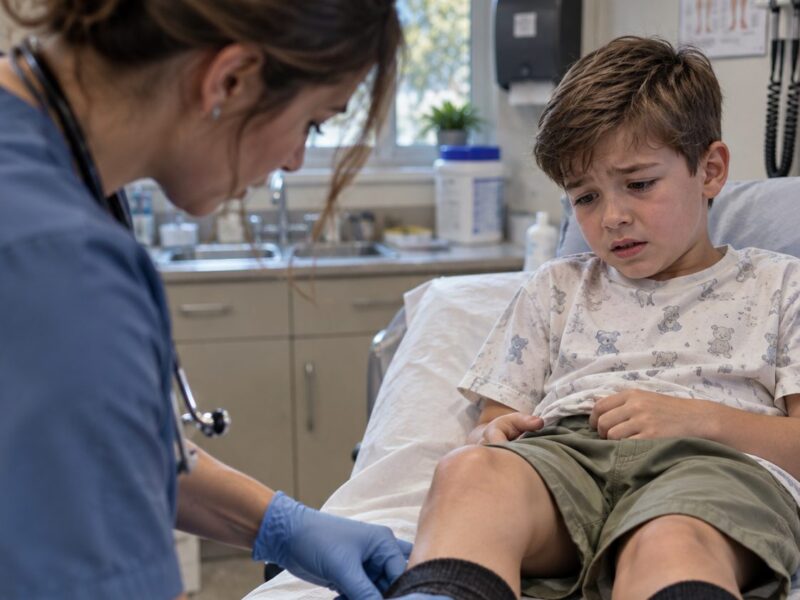
Police eventually secured the situation and arrested Mark. Specialists then examined the device before safely removing it. At the family home, officers found Elena safe and unharmed.
When Leo learned that his mother was safe, he was finally able to release the emotions he had been holding back for weeks. He was taken to the hospital to receive treatment for his serious heat-related condition and the injuries caused by the device.
Six months later, Leo returned to the school with his mother. He seemed transformed: more relaxed, happier, and, most importantly, free from fear. He was wearing ordinary, lightweight socks. He walked into the nurse’s office and thanked Sarah.

This story is a reminder that vulnerable children do not always know how to ask for help. A seemingly ordinary change — such as unusual clothing in hot weather, silence, or anxiety — can sometimes point to a much more serious situation.
Sarah and Ms. Gable did not have all the answers. They simply noticed that something was wrong, took Leo seriously, and acted with caution. Sometimes, protecting a child begins with noticing one small detail and asking one simple question: Why?