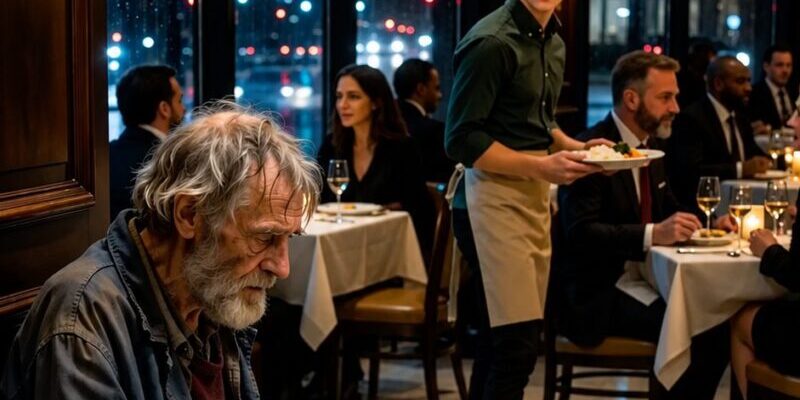
A hungry waiter gave his only meal to an elderly man despised by the customers, then was fired… before discovering who Henry Brooks really was…
That evening, a violent storm was hitting Manhattan.
Inside the luxurious Beaumont Grand Hotel, wealthy guests were dining in an elegant and warm atmosphere.
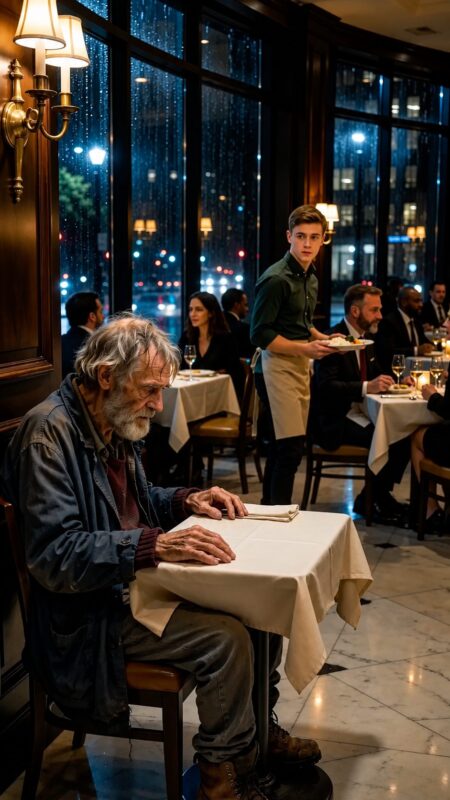
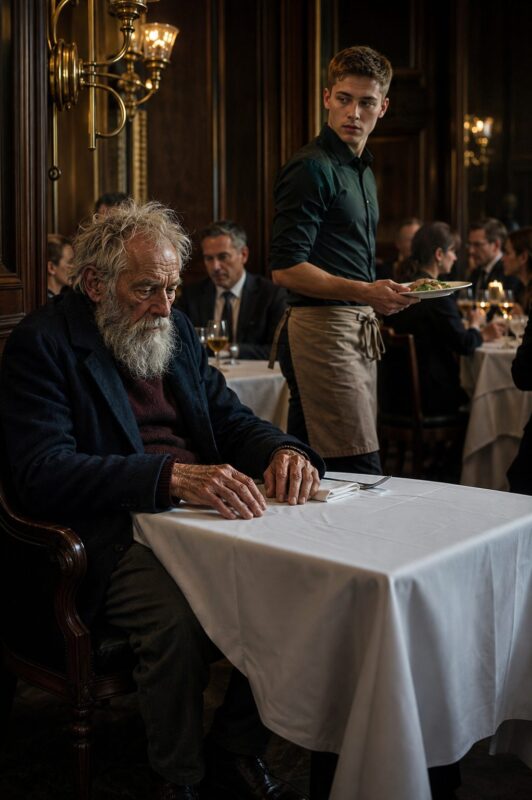
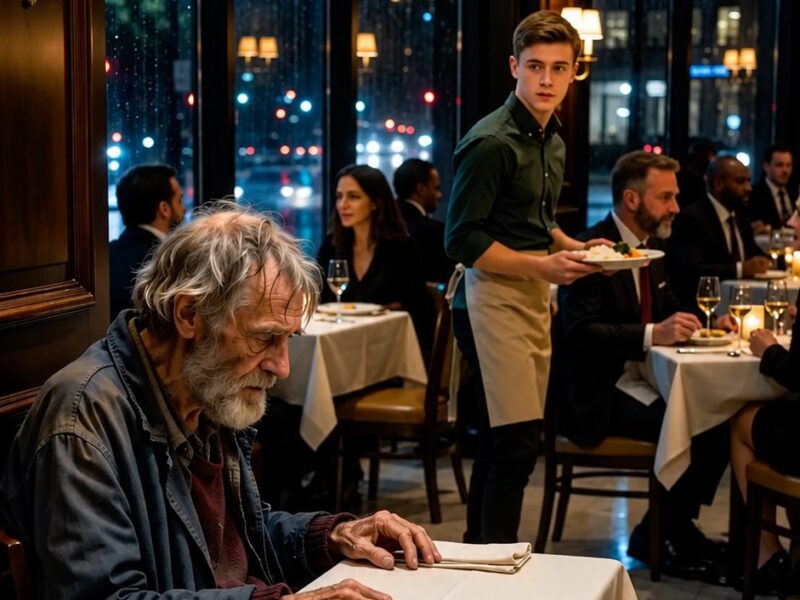
At table seventeen, an elderly man was sitting alone.
His name was Henry Brooks.
Seventy-five years old, thin, exhausted, and wearing an old coat soaked by the rain. He looked so poor that several guests wondered why he was even in such a prestigious hotel.
Henry asked for nothing.
But Jake Miller, a twenty-two-year-old young waiter, noticed something everyone else had overlooked:
Henry was hungry.
A little later, Jake went into the staff room to eat his only meal of the day. He had not eaten anything since morning.
Looking at his plate, he thought about the old man.
He returned to the dining room and placed his dinner in front of Henry.
— This isn’t mine, Henry said.
— It is now.
— You don’t have to do this.
Jake smiled.
— I’m not very hungry.
That was a lie.
Henry knew it.
Jake knew it too.
But he didn’t want to embarrass him.
A few minutes later, the hotel manager, Michael Grant, arrived.
He was furious.
— Staff meals are not for guests.
Jake replied:
— He needed it.
Michael ordered him to leave.
Jake refused to leave the table until Henry had finished his meal.
Michael finally said:
— You’re fired.
Jake took off his badge.
— I’d make the same choice again.
Henry lowered his eyes toward his plate.
For him, this simple dinner would soon take on an importance Jake could not yet imagine.
But for now, no one in the restaurant knew what was about to happen—or who Henry Brooks really was…
To find out more, read the article in the first comment 👇👇
PART TWO — WHAT JAKE WAS ABOUT TO DISCOVER
The next day, Jake was summoned to the management offices.
He thought he would simply have to answer for what he had done the previous evening.
But when he entered the meeting room, he quickly realized that this story was far more important than he had imagined.
Henry was there.
This time, his demeanor was different.
He explained to Jake that he had come to the Beaumont for a specific reason.
His wife, Sarah, had died eight months earlier.
Years before, when they were young and poor, Sarah and Henry had also experienced hunger and hardship.
One stormy evening, an employee at a small hotel had given them coffee and sandwiches when they couldn’t afford to pay.
Sarah had never forgotten that gesture.
Later, when Henry became wealthy and founded Brooks Hospitality, Sarah established a rule:
No one in need should ever be humiliated because they didn’t have money.
But after her death, Henry discovered that this philosophy had gradually disappeared from his company.
Free meals had been reduced.
Poor people had become “problems.”
So Henry decided to visit several of his hotels anonymously, dressed like someone with no money.
The Beaumont was the seventh.
And Jake had been the only employee to see a hungry man before seeing a problem.
Henry then asked Jake:
— What do you think I should do?
Jake replied:
— Don’t just fire Michael. Otherwise, everyone will say that he was the problem.
Henry looked at him carefully.
— Then what should I do?
— Make him fix what he helped impose.
That answer would change everything that happened next.
PART THREE — THE PRICE OF DOING WHAT IS RIGHT
A few months later, another storm hit New York.
Snow brought the city to a standstill.
Dozens of people were left without heat or shelter.
This time, Michael reacted differently.
He opened the Beaumont’s doors.
The ballroom was transformed into a shelter.
The kitchen served soup.
Employees donated clothes.
Guests offered blankets.
No one asked the people being welcomed how much money they had.
Jake arrived in the middle of the night and found Michael carrying chairs.
— Managers don’t normally do this, Jake joked.
Michael smiled.
— I’m evolving.
Henry arrived a few hours later.
He watched the families, employees, and strangers sharing the same room.
He thought about Sarah.
Jake said to him:
— This is what she wanted.
Henry replied:
— Yes.
Then he realized something.
He had spent years trying to save his company.
But it wasn’t the company that mattered.
It was the people.
When the board of directors wanted to turn the new program into a marketing tool, Henry made a decision.
He sold the majority of his shares in Brooks Hospitality.
A large portion of his money was placed into the Sarah Brooks Foundation.
Its goal was simple:
No one should ever be humiliated because they need help.
Jake joined the foundation to develop the program.
PART FOUR — TABLE SEVENTEEN
Two years later, Henry and Jake returned to the Beaumont for dinner.
They asked for table seventeen.
Everything had changed, but the table was still there.
During the meal, Henry said:
— You were right.
— About what?
— You said that if you got your job back only because I was important, nothing would really change.
Jake smiled.
Henry looked around the room.
— The dinner mattered before anyone knew my name.
At the entrance to the restaurant, a drenched man walked in and asked if he could wait until the rain stopped.
The manager pointed him toward a chair by the fireplace.
A few minutes later, a waiter brought him coffee and food.
No one asked who he was.
No one tried to find out whether he was rich.
No one filmed the scene.
Henry watched silently.
— This is what Sarah wanted, he whispered.
Years passed.
The Sarah Brooks Foundation grew and opened several centers providing meals, emergency shelter, and job training.
Jake became one of its leading executives.
Henry, meanwhile, grew old.
Before his death, he gave Jake one final letter:
“You gave me your dinner when you thought I had nothing to give you in return. Never let the world convince you that it was foolish.”
Five years later, the Beaumont renovated its restaurant.
Everything changed except one thing.
Table seventeen remained exactly where it had always been.
New employees were taught its story.
But not the story of the billionaire.
Not the story of the lawyers.
Not the story of the black SUVs.
They learned the story of a young waiter who had given his only meal to a hungry stranger.
Because the real lesson wasn’t that Henry Brooks was rich.
The real lesson was much simpler:
We should never need to know who someone is before deciding that they deserve to be treated with dignity.